Showing posts with label Steam. Show all posts

Friday, February 27, 2009

Management of Steam Asset

Display problem ? Click HERE

Recommended :
- Subscribe FREE - Chemical Engineering
- Tips on Succession in FREE Subscription
Steam is one of the most commonly use medium to transfer energy from one point another point, room and system heating, power generation, cleaning, etc. Steam also can be used to assist combustion as discussed in "Steam in FIRE...". Steam is clean, easy to manage, predictable properties and engineer is "understand" behavior of steam after few century of experiences.

Steam once give it energy for process fluid heating, conversion to power energy via steam turbine, etc, it will probably form condensate and return to boiler for steam regeneration. Entire heat input, steam generation, heat transfer, condensate formation and finally return back to boiler again form a complete steam-condensate loop. The steam-condensate balance may be conducted using process simulator such as HYSYS, Pro-II, etc. Manual balance may be conducted as in discussed in "Conduct Steam-Water Balance MANUALLY using Water97_v13". Besides there are plenty of useful tools and guideline as listed in "Steam - Condensate Useful Links...". For those new subscriber, check it out.

This post would like to bring to you a very great "movie" about steam asset management, presented by Armstrong. The discussion includes :
  • Becoming "trap active" with steam trap survey
  • Web based data management
  • Common global reporting platform
  • Steam trap diagnosis tools
  • Real time information integration
Click image to download the movie (25.3M) and open with Windows Media Player.


To read FAQ about this presentation, click here.

Related Topic

Tuesday, February 3, 2009

Problems and Measures for Condensate Recycle Control Valve

Display problem ? Click HERE


Steam
is commonly used in oil & gas, refinery, petrochemical and power plant for heating and power generation. Steam is condensed in equipment for heating and in turbine for power generation. Condensate is then collected in common collector before it is sent to condensate drum. Condensate from drum is then pumped to Boiler for steam generation via a Boiler Feed Water (BFW) pump. BFW is normally a centrifugal type and a minimum flow recirculation line is provided on BFW discharge for pump protection.


Minimum flow control can be
  • a flow meter on pump discharge with control valve on recycle line
  • a flow-Delta P and flow meter on pump discharge with control valve on recycle
  • an automatic Recirculation Valves (ARC) valve
as discussed in "Centrifugal Pump Minimum Flow Control Strategies". Restriction orifice option is not normally used due to energy saving, avoidance of continuou noise and vibration.

Problems
There are several problems assocaited with these valves in condensate recycle line :

i) Erosion - flashing and cavitation results trim and body erosion
ii) Severe noise and vibration - flashing and cavitation
iii) Leakage - energy loss

Recommendation
Several recommendations to miniminse above mentioned problems :
i) Harden trim to resist erosion cause by flashing and cavitation

ii) Correct material i.e. alloy selection to avoid erosion-corrosion

iii) Anti-cavitation trim to minimise / avoidance of cavitation.

iv) Multi-stage anti-cavitation trim for small valve

v) Multi-hole anti-cavitation trim for large valve

vi) Multi cage anti-cavitation trim for high pressure recovery (FL) valve

vii) High lift (more than 20% lift) valve to increase trim life

viii) Large body valve to minimise velocity (high velocity lead to high erosion) in the valve inlet and outlet chambers. [Tips : Body erosion proportional to 3-5 power of velocity]

ix) Elevate condensate drum to increase back pressure to the valve (if possible)

x) Provide restriction orifice downstream of control valve to increase back pressure. One shall take note at low flow, the pressure drop acrosss RO is negligible. Majority pressure drop (energy being "killed") still occurred at valve

xi) Tight shut off (class V) valve to avoid leakage and hence energy loss.


Related Topic

Wednesday, September 3, 2008

Understand Boiler Efficiency

Display problem ? Click HERE

Recommended :
- Tips on Succession in FREE Subscription
- Subscribe FREE - Today Energy Solution

Today energy cost is sky high and everybody chasing to find new source of energy. Nevertheless, less people would put much attention in increasing efficiency. Efficiency us understood as what you get compare to what you put in. Nevertheless in many events, there are confusion in defining efficiency. There are several "efficiency" terms used in boiler i.e. combustion efficiency, thermal efficiency, fuel-to-steam efficiency, boiler efficiency, etc.

What are the differences ?

"Combustion efficiency" is burner’s ability to burn fuel where it measure amount of unburned fuel and excess air in the exhaust compare to fuel being fed to the burner. It is often used to evaluate burner’s performance. Combustion efficiency is generally higher for gaseous and liquid fuels follow by solid fuels. A well designed burner generally firing gaseous and liquid fuels at excess air levels of 15%.

"Thermal efficiency" is fuel-to-heat efficiency which does not take in account of radiation and convection losses.

Boiler efficiency” in many events is understood as thermal efficiency or fuel-to-steam efficiency. Infact thermal efficiency is different than fuel-to-steam efficiency. Fuel-to-steam efficiency does take in to account of radiation and convection losses. It is a overall boiler efficiency from quantity of fuel consumed to quantity of steam generated.

Above definitions would lead to confusion of some engineers during selection of boiler. Thus, proper communication and definition of efficiency given by a particular boiler vendor is very important.

Facts About Firetube Boilers & Boiler Efficiency

This is an Efficiency Facts Booklet is designed to clearly define boiler efficiency. It will also give you the background in efficiency needed to ask the key questions when evaluating efficiency data, and provide you with the tools necessary to accurately compare fuel usage of boiler products, specifically firetube type boilers.

In this booklet, you may find :
  • Several key factors to understanding efficiency i.e. Flue gas temperature, Stack temperature, Fuel specification, Excess air, Ambient air temperature and Radiation and convection losses.
  • Fuel-to-Steam Efficiency versus Flue Gas Temperature Curve
  • Efficiency versus H-C ratio
  • Efficiency versus O2 concentration
  • Efficiency versus Ambient Temperature
  • Fuel cost comparison for boiler with different efficiency
  • Efficiency estimation based on Stack temperature
Download

Related Topic

Thursday, August 28, 2008

Simple Formula To Estimate Water Viscosity

Display problem ? Click HERE

Recommended :
- Tips on Succession in FREE Subscription
- Subscribe FREE - Processing & Control News

There are many ways to obtain the Dynamic viscosity of water. You may use Steam table, Excel calculator using Water97_v13 add-in, Steam Calculator (web), SteamTab program, simulator like HYSYS, etc. All above required you to have the material on hand.

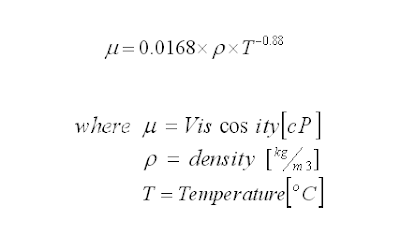
Following is a simple equation to estimate the Dynamic Viscosity of Water. It is easy to be written in your notebook or memorize.

*Applicable in water temperature of 25-250 degC

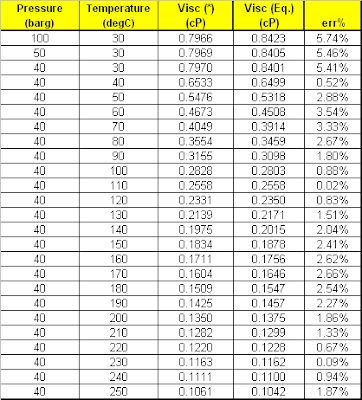
Earlier post "Conduct Steam-Water Balance MANUALLY using Water97_v13" has discussed the Dynamic Viscosity can be extracted using a special function, viscW(T,P) in Excel Add-on in (Water97_v13.xla or Alternative download). The dynamic viscosity of water at different temperature from 30 to 250 degC (at 40 barg) have been predicted using Water97_v13.xla and Dynamic Water Viscosity formula . Results tabulated as follow :


The error is 01-3.5% with maximum 5.75% at low temperature. It is consider rather sufficient from engineering perspective and pretty useful when you have nothing on hand.

Related Topic

Thursday, June 12, 2008

Square-root-Square-root Formula Ease Saturated Steam-Codensate Temperature Prediction

Display problem ? Click HERE

Recommended :
You are assigned to site to make a site visit. Your task is to investigate the serious water hammering issue in the condensate line. In the plant, you found a condensate return line with a pressure gauge indicating 10 barg, you would like to know the temperature of the condensate.


What is the quickest way to find this temperature with your pocket calculator ?


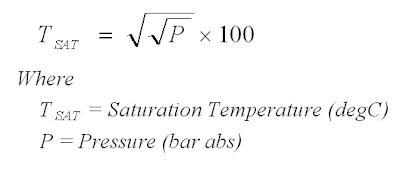
The simple Square-root-Square-root formula will help you. The formula is :


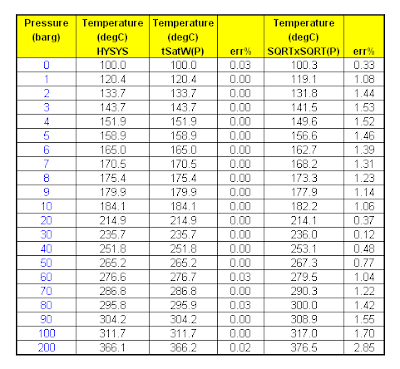
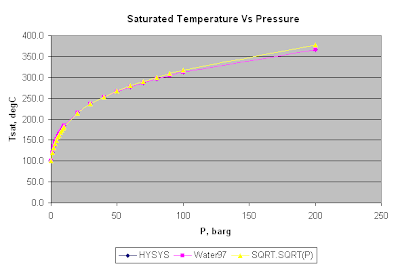
Earlier post "Conduct Steam-Water Balance MANUALLY using Water97_v13" has discussed the saturate steam - condensate temperature can be extracted using a special function, tSat(P) in Excel Add-on in (Water97_v13.xla or Alternative download). Of course, HYSYS has the capability of predicting the saturated steam-condensate temperature. The Saturation temperature at different pressure from 0 to 200 barg have been predicted using HYSYS, Water97_v13.xla and Square-root-Square-root formula. Results tabulated as follow :


Above simple studies showed that :
  • tSATW(P) function in Water97_v13.xla is virtually same as HYSYS prediction. Error is negligible.
  • Square-root-Square-root formula (compare to HYSYS) constantly over predict saturation temperature over the pressure range from 0-200 barg.
  • Square-root-Square-root formula (compare to HYSYS), over-predict is increased with pressure.
  • Square-root-Square-root formula (compare to HYSYS) prediction error in the range of 0.3 to less than 3%.
In view of above error, 0.3 to 3% error is rather small and Square-root-Square-root formula can be used to make a quick prediction of saturation temperature for steam-condensate.

Updated on June 15, 2008
- Unit P shall be in bar abs instead of barg. Thanks to
Manjushinee.

Related Topic

Saturday, February 23, 2008

SteamTab - A simple Executable file for Steam - Water Properties...

Display problem ? Click HERE

One fine day, you are in the meeting and you have been asked to about the properties for steam at 10 barg & 200 degC. You can either
Recommended Utility :
Spottt - Free Link Exchange...

Use Excel may required to remember the function and steam-condensate may required you to login to internet. Sometime the server which steam-condensate calculator may down for some reason. Using steam table would definitely time consuming. One of way is to use the SteamTab steam-condensate software which is rather handy for you.


Similar to the excel add-on, you may obtain steam-condensate properties for subcooled, saturated and superheated condition. In additional to common properties, it also calculated other parameter such as surface tension, Gibbs energy, etc.

If you have problem in obtaining this handy tool, please drop me a note.

Related Topic
Continue receive FREE stuff & Update.......Subscribe by Email OR RSS
Any comments / advices ?..........Drop it in comment field (below) or send a private email to me...

Thursday, February 14, 2008

Conduct Steam-Water Balance MANUALLY using Water97_v13

Display problem ? CLICK HERE

Recently i was supervising a young engineer in the design of Steam - Water system for an LNG plant. This kind of system can be easily simulated in any Process Simulator such as HYSYS, PRO-II, etc and generate a Heat & Material Balance (HMB). If you have several years experience, you may notice that nowadays young engineer tends to use Process simulator and ignoring the basic behind. Due to this reason, i insisted the young engineer to conduct Heat & Material Balance for Steam -water system MANUALLY using Excel spreadsheet. Without any surprise the young engineer having difficulties...


In "Useful Steam - Condensate Calculator", there is an Excel Add-in (Water97_v13.xla or Alternative download) available FREE for download, is very useful for calculating thermodynamic and transport properties of water and steam using the industrial standard IAPWS-IF97. In this post, i will elaborate a little bit on the method to conduct steam-water balance manually using above add-in.


Problem statement :
High pressure steam (HS) at 20 barg @ saturated condition mix with Boiler Feed Water (BFW) at 15 barg @ 60 degC to 1000 kg/h Low Pressure Steam (LS) at 3.5 barg @ Saturated condition. Find quantity of HS & BFW.

Material Balance :
M1 + M2 = M3
M2 = M3 - M1
Heat Balance :
M1 x h1,vs + M2 x h2,T = M3 x h3,vs
M1 x h1,vs + (M3-M1) x h2,T = M3 x h3,vs
M1 x h1,vs + M3 x h2,T - M1 x h2,T = M3 x h3,vs
M1 x h1,vs - M1 x h2,T = M3 x h3,vs - M3 x h2,T
M1 x (h1,vs - h2,T) = M3 x (h3,vs - h2,T)
M1 = M3 x (h3,vs - h2,T) / (h1,vs - h2,T)
a) For HS Steam : Get Specific enthalpy (h1,vs) for Saturated steam at pressure 20 using enthalpySatVapPW (P)
[e.g. enthalpySatVapPW(20+1.01325)]
b) For BFW : Get Specific enthalpy (h2,T) for Subcooled liquid at 15 barg @ 60 degC using enthalpyW(T,P)
[e.g. enthalpyW(60+273.15, 15+1.01325)]
c) For LS Steam : Get Specific enthalpy (h3,vs) for Saturated steam at pressure 3.5 using enthalpySatVapPW (P)
[e.g. enthalpySatVapPW(3.5+1.01325)]
d) As M3 is 1000 kg/h, M1 & M2 can be obtained by modeling it in the EXCEL sheet.
For M1 :
=1000 * (enthalpySatVapPW(3.5+1.01325) - enthalpyW(60+273.15,15+1.01325))/ (enthalpySatVapPW(20+1.01325) - enthalpyW(60+273.15,15+1.01325))
For M2 :
= 1000 - M1
Another method is using GOAL SEEK in EXCEL sheet...
M1 & M2 can be adjusted until the enthalpy difference between INLET section (e.g. M1 x h1,vs + M2 x h2,T ) and OUTLET section (e.g. M3 x h3,vs) equal to zero AND M1+M2 = M3. The adjust function can be easily setup using GOAL SEEK feature in EXCEL.

Details may refer to following image.


It is rather simple programming as seen from above and no simulator is required.

Young engineer is always encourage to conduct above calculation as least 2-3 times so that you are sure yourself understand heat & material balance in depth. By doing this kind of calculation, you will surprise your depth understanding. Later stage, you can always simulate balance with process simulator to save time.

For those who are interested in the EXCEL spreadsheet, you may drop a note to me.

Related Topic

Continue receive FREE stuff & Update.......Subscribe by Email OR RSS
Any comments / advices ?..........Drop it in comment field (below) or send a private email to me...

Wednesday, February 13, 2008

Useful Steam - Condensate Calculator


Display problem ? Click HERE


Recommended Utility : LOCKIMAGE - Passwaord Protect Images

One fine day you are at site, you are engineer assigned to site to carry out series of steam - condensate line flushing. You will have to find the properties (e.g. enthalpy, entropy, density, etc) for superheated steam , steam & condensate at saturated conditions and subcooled condensate, one of the easiest method is use a FREE Excel Add-in (which recommended many months ago in "Steam - Condensate Useful Links...").

Note : If you are dealing with Steam & Condensate, there are plenty of good stuff in Steam - Condensate Useful Links...(Click HERE)
Water97_v13.xla (Alternative download) is a very useful MS EXCEL Add-In for calculating thermodynamic and transport properties of water and steam using the industrial standard IAPWS-IF97.
In the event you would like to back check what you have installed and programmed is correct or quick checking on the properties or you do not want to goes through the difficulties, you may find this Steam-Condensate Calculator (click here) pretty useful for you. Thanks to Jacques for recent recommendation.

If you found any good & reliable related sites, please drop me a note (click HERE) for sharing...

Related Topic

Continue receive FREE stuff & Update.......Subscribe by Email OR RSS
Any comments / advices ?..........Drop it in comment field (below) or send a private email to me...

Wednesday, April 18, 2007

Useful Documents Related To Steam - Condensate


Recommended :

IAPWS is an international non-profit association of national organizations concerned with the properties of water and steam, particularly thermophysical properties and other aspects of high-temperature steam, water and aqueous mixtures that are relevant to thermal power cycles and other industrial applications.

Following tabulate listing of useful documents and links for STEAM & WATER engineering... if some of you have better site, please drop me a comments...


Steam Conservation Guidelines Handbook (Source : Armstrong)
Armstrong has been sharing know-how since they invented the energy-efficient inverted bucket steam trap in 1911. In the years since, customers’ savings have proven again and again that knowledge not shared is energy wasted. Armstrong’s developments and improvements in steam trap design and function have led to countless savings in energy, time and money. This section has grown out of our decades of sharing and expanding what we’ve learned.It deals with the operating principles of steam traps and outlines their specific applications to a wide variety of products and industries. This section also includes Recommendation Charts that summarize our findings on which type of trap will give optimum performance in a given situation and why.

Condensate Recovery Handbook (Source : Armstrong)
The most basic part of energy management is utilizing all valuable Btu within the steam system. Depending on the pressure, condensate exiting a trap contains approximately 20% of the heat energy transferred at the boiler in the form of sensible heat. Effective recovery of condensate reduces three tangible costs of producing steam :

  • Fuel/energy costs associated with producing steam
  • Boiler water make-up and sewage treatment
  • Boiler water chemical treatment
These savings can be calculated using the attached savings form. Returning condensate saves money, energy and the environment. Pour money and energy savings back into your plant—not down the drain.

Steam Engineering Tutorial...
A
comprehensive information and knowledge on Steam Engineering and Heat Transfer site (Source : Spirax Sarco)


Water97_v13.xla (Alternative download)
A very useful MS EXCEL Add-In for calculating thermodynamic and transport properties of water and steam using the industrial standard IAPWS-IF97. (source : Cheresources)


Steam67.zip contains compiled dll version of the 1967 ASME Steam Tables and an Excel 97 example of using it. (source : KORF)  

Steam Table
A web-base steam table generation for different Steam-Water regions :

(source : Spiraxsarco


Thermo Utilities v3.0(1.75 Mb) offers a large number of functions for calculating the properties of water, steam, air, flue gases and other fluids. The functions used for steam and water properties are based on a set of equations accepted by the members of the Sixth International Conference on the Properties of Steam. The sets of equations are also known as "IFC Formulation for Industrial Use". Thermo Utilities calculates the properties of dry air, moist air, exhaust and flue gases by using equations accepted by ASHRAE and CIBSE (Chartered Institute of Building Services Engineers). Lee-Kesler method used in this package can be applied to a large number of chemicals for estimating thermodynamic properties. The database accompanied with this package for use with Lee-Kesler method supports more than 450 chemicals. The package also offers a large number of inverse functions which are useful for applied thermodynamics calculations. (source : Taftan Data)


SteamTab™ (demo) add-in software, new water and steam properties formulation approved by the International Association for the Properties of Water and Steam (IAPWS)