Showing posts with label NRV. Show all posts

Sunday, November 16, 2008

Check Valve Types and Selection

Display problem ? Click HERE


Recommended :
Subscribe FREE - Processing Magazine

Check valves or Non-return valves (NRV) are normally installed in piping to avoid back flow. Rotating equipment such as pump, compressor, etc will always be equipped with NRV(s) on the discharge to avoid back flow when rotating equipment is shut. Back flow creates severe surging to the rotating equipment and potentially damage the equipment. In certain process system, NRV will be employed to avoid contamination, overheating, etc due to back flow.

Check valves or Non-return valves (NRV) is basically an automatic valve open to allow forward flow and close to against reverse flow. In principle, it split into four basic types. There are swing, dual-plate, tilting disc and lifting type. Wrong selection of check valve type can leads to operability problem, leakage and continual maintenance issue.

Lift Check valves
- higher pressure drop is expected.
- equipped with small return spring to facilitate valve closure on reverse flow
- two type of seat. hard seat for for high differential pressure sealing and resilient seat for low differential pressure sealing
- shortest travel length. Fastest response.
- excellent performance for low and/or pulsating flows
- not good for fluid with particles
- Body install horizontal with disc / piston vertically
- Small check valve range from 1/2" to 2" lift piston type check valve
- Prefer operate in full open position

Minimum Recommended Line Velocity, Vmin (ft/s) = 12 SQRT (v)

where
v = Specific Volume of the Fluid (ft3/lb)


Lift Check Valve

Swing Check Valve
- Tight sealing / shut-off
- Low pressure drop
- Susceptible to water hammer
- Not good for low flow and/or pulsating flow
- Vertical (upward flow) & horizontal installation
- Easiest check valve to maintain
- Prefer operate in full open position

Swing check valves should be sized such that the flow velocity in the line is sufficient to hold the disc in the fully open position.

Minimum Recommended Line Velocity, Vmin (ft/s) = 75 SQRT(v)

where
v = Specific Volume of the Fluid (ft3/lb)


Swing Check Valve

Dual plate Check valve
The characteristic of dual plate check valve is pretty same as swing check valve.
- low pressure drop
- Not good for low flow and/or pulsating flow
- Vertical (upward flow) & horizontal installation
- Faster opening and closure compare to swing check valve
- Susceptible to water hammer (lesser than Swing check valve)
- Prefer operate in full open position


Dual Plate Check Valve

Tilting Disc Check Valves
- Fast opening and closing without damage to disc and seat
- Stable at low and pulsating flows
- Moderate pressure drop. Lower than lifting check valve but higher than swing check valve
- Vertical (upward) & horizontal installation
- Moderate tight sealing
- Prefer operate in full open position

Minimum Recommended Line Velocity, Vmin (ft/s) = 24 sqrt (v)

where
v = Specific Volume of the Fluid (ft3/lb)


Tilting Disc Check Valve


Selection Consideration
There are four (4) main criteria shall be considered for the selection of check valve type :
  • non-slam characteristic
  • pressure loss
  • cost
  • application
Comparative rating for each type of check valve have been provided for these criteria (specifically first two technical criteria). These rating will be plotted on a Check Valve Comparative Selection Chart and together budget for final selection. Read more in "Design and Selection of Check Valve".

Related Post

Thursday, October 30, 2008

Several Strategies To Minimize Relief Capacity in Back-Flow Scenario

Display problem ? Click HERE


Recommended :
Subscribe FREE - Chemical Processing
Multi-stages compressor with intermediate cooling and liquid knock-out is commonly applied in compressing gas from low pressure (say 6 barg) to very high pressure (say 60 barg). This may required 2-stages compression using centrifugal compressor. Intermediate pressure at interstage compressor section could be one-third or half of discharge pressure of final compression stage. Thus in many event, the final stage compression section and intermediate section will have the higher design pressure whilst suction section will have lower design pressure.

Check valve is normally used to install between the two section with different design pressure. Check valve failure (stuck open or leakage) is one of the credible scenario which shall be considered. One of the question is in this check valve failure case, how much back flow shall be considered and how to reduce back-flow and minimize suction Pressure relief valve (PRV) relief capacity ?

Following are some strategies can be considered :

a) Single Check Valve
If single check valve is installed, one shall consider the check valve possibly stuck open. This results 100% back flow through the check valve.

b) Single Check Valve plus Single Shut-down valve
If single check valve and single shutdown valve are installed, one shall consider the check valve possibly stuck open. Although Shutdown valve is available for shut-close purpose, the reliability of single shutdown valve is still insufficient to act as ultimate safeguarding purpose. Thus, this results 100% back flow through the check valve.

c) Double Check Valve
If additional check valve with different technology and manufacturer, one may consider one check valve is stuck open and second check valve is still in place to perform it duty. Nevertheless, one shall not consider the second check valve is 100% reliable and leakage is still possible. Thus, one of the recommendation is to consider 1st check valve full open second check valve leak with 10% check valve flow area.

d) Single Control Valve, Single Check Valve Plus Single Shutdown Valve
If single control valve, single check calve plus single shutdown valve in series are installed and there are at lease two trips are available to trigger back-flow occurrence, this arrangement may be considered acceptable as ultimate safeguard. However, a proper Instrumentation Protective Functional (IPF) studies shall be conducted to confirm.

Import and Debatable Remarks
Fluid Cleanliness Nature - Having say that, above has considered the fluid is clean (no fouling and solid) and will not cause check valve unable to prevent reverse flow. The cleanliness of fluid is one of the critical factor shall be analyzed to derive the safeguarding strategy.

Operation Experiences - Besides cleanliness of fluid, any possible corrosion and surging of system may lead to damage of check valve internal. Some operation experiences shown that there is possibility of check valve internal damaged without operator awareness. Thus, well maintenance procedure and testing and checking procedure is also part of the factors to be considered.

Concluding Remarks
Above strategies may be considered to minimize or eliminate back flow scenario, however a details analysis shall be conducted.


Related Post

Wednesday, October 1, 2008

Basis & Tips on Setting Centrifugal Pump "Warming" Recycle Flow

Display problem ? Click HERE

Earlier post "Why bypass Non-Return Valve (NRV) ?" discussed the purpose of providing manual block valve across Non-Return Valve (NRV) on centrifugal pump discharge. Typical the purpose covers :
  • Pump priming
  • Pump warming
  • NRV downstream section draining


Recommended :
Subscribe FREE - Chemical Processing

Now the question is focus on pump warming. What is the basis of setting this recycle flow rate ? Lets first define the purpose, how it is implemented and how to set the flow.

Purpose
The main purpose of the bypass line is to maintain a minimum temperature different between the pump (and associate piping ) and the pump suction fluid temperature to avoid temperature shock in the event of standby pump is started-up automatically.

How it is implemented ?
The bypass can be
  • fixed restriction orifice (RO) or;
  • non-return valve (NRV) with hole or;
  • globe valve
How much flow ?
The bypass flow rate should be sufficient to cater for :

i) Start-up : pump and associate piping heat-up from minimum ambient to normal suction temperature within a reasonable time i.e. 2 hours
ii) Normal operation : heat leakage via insulation during normal operation

Tips

Tuesday, May 27, 2008

Potential Problem associate with Double NRV in Series within a Line

Display problem ? Click HERE


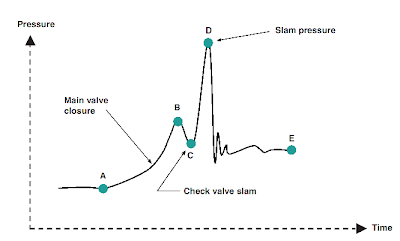
Discussion in "How to predict Check Valve Slam ?" has shown potential of surge pressure if a normal check valve is provided in the pump discharge. Nevertheless, in many design the surge pressure could be within the allowable limit of piping short term pressure spike. Thus, it is "normally" that providing a normal check valve on pump discharge does not poses any danger of pressure surge. Having said this, a proper checking should be carried out.

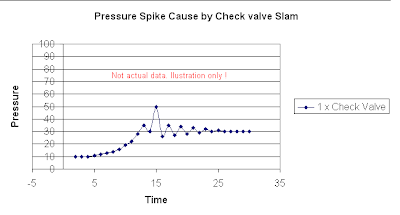
One of the scenario that has been warned for many times is providing double check valves in the pumping system. With single normal check valve in the pump discharge line, the discharge may experience a short term pressure spike as shown in image below.


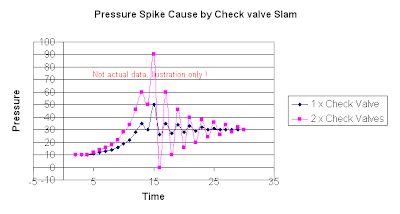
In case of double check valves in the pumping system, there may be a very short time gap between the closure of both check valves. This would allow both check valves generate two pressure waves running forward and backward along the pumping system. Two waves would probably meet along the piping. Both waves' amplitude could be added or subtracted between each and other subject to wave's pattern. A severe pressure spike could be additional of two identical waves as shown in the following image.


Above discussed about the potential of severe pressure spike in the pumping system with double check valves, however, it very subject to :

  • Shutdown valve closure time
  • Pump shutdown time and its impact on the pressure waves
  • Piping length
  • Location of the check valves
  • Check valves type and its closure time
thus, providing double check valves does not mean severe pressure spike will definite happen. However, the potential of severe pressure spike increases as well as it associate risk. Only proper pressure surge study and review on the wave and pressure spike pattern can advise the likelihood of occurrence.

Related Post

Wednesday, March 19, 2008

How to predict Check Valve Slam ?

Display problem ? Click HERE


Check valve slam is one of the common problem encounter in rotating equipment discharge e.g pump, compressor, etc. As mentioned in earlier post "How to Select a Check Valve (NRV) Quantitatively ?" one of the requirement is for a "good" check valve is non-slam characteristic.

For a pumping system with a check valve installed on the discharge, whenever the pump is shut, reverse flow is formed quickly and approaching check valve. One of the requirement to avoid check valve slam is the check valve shall be closed faster than the reverse flow acting on the disc. You may the following animation and see how a check valve with the disc closure is faster than the reverse flow and avoid damage of check valve and severe surge pressure.


As the closure of valve disc is affected by few factor such as disc travel distance, reverse flow travel length, etc. How should you predict if a check valve would experience slam and severe surge ?

A methodology for predicting check valve slam is one of the article you may read to identify if a selected check valve would experience slam during closure time.

Related Post


Continue receive FREE stuff & Update.......Subscribe by Email OR RSS
Any comments / advices ?..........Drop it in comment field (below) or send a private email to me...

Monday, March 17, 2008

How to Select a Check Valve (NRV) Quantitatively ?


Display problem ? Click HERE


Check valves or Non-return valves (NRV) are normally installed in piping to avoid back flow. Rotating equipment such as pump, compressor, etc will always be equipped with NRV(s) on the discharge to avoid back flow when rotating equipment is shut. Back flow creates severe surging to the rotating equipment and potentially damage the equipment. In certain process system, NRV will be employed to avoid contamination, overheating, etc due to back flow.

See the following animation how a dual disc check valve action to avoid back flow.


Courtesy of Goodwin

There are many types of check valve (NRV) available such as ball check valve, lift check valve, swing check valve, wafer check valve, disc check valve, dual disc check valve, tilted disc check valve, etc.

For details discussion on each type of check valves, please check out :
Out of many types of check valve, how do you make proper selection to suit your application ? An article by VAL-MATIC entitled "Design and Selection of Check Valve" is available for download. This article presented four (4) criteria which shall be considered for the selection of check valve type. There are :
  • non-slam characteristic
  • pressure loss
  • cost
  • application
Comparative rating for each type of check valve have been provided for these criteria (specifically first two technical criteria). These rating will be plotted on a Check Valve Comparative Selection Chart and together budget for final selection.

Related Post


Continue receive FREE stuff & Update.......Subscribe by Email OR RSS
Any comments / advices ?..........Drop it in comment field (below) or send a private email to me...

Thursday, March 6, 2008

Why Redundant NRV in Series within a Line ?

Display problem ? Click HERE


One of my blog reader, DV post a simple question to me recently.
"There are two non return valves (NRVs) in an oil transfer line. 1st NRV on transfer pump discharge and 2nd NRV located some distance away before it tie in to another oil pipeline. Why two NRVs in a single line ?"
Quick response on this question is

NRV internal e.g. flapper, piston, etc is prompt to failed and damage cause by corrosion, erosion, etc. Thus, to increase reliability and reduce probability of reverse flow, redundant NRV is provided on same lime. This is pretty inline with API Std 521 recommendation. In additional, API Std 521 allow credit (reduction) on flowrate in back flow and minimize relief load. This commonly apply in compressor discharge Non-Return Valves (NRV).

Thus provision of additional NRV :
  • Redundant NRV increases reliability and reduce probability of back flow
  • Credit on flow reduction in back flow
Do you aware of any other purpose ? Share with us (click here).

Will discuss further of "
Potential Problem associate with Redundant NRV in Series within a Line"

Related Post

Sunday, May 27, 2007

Why bypass Non-Return Valve (NRV) ?


Someone raised a question :


Non-Return Valve (NRV) is provided on centrifugal pump discharge to avoid pump damage due to backflow. In some special case, designer provide a manual block valve across the NRV. Why ? Isn't it defeat the purpose of NRV ?


Infact there are several reasons behind this application...


Art Montemayor :
" 1. Prime the pump with the discharge fluid that is on the downstream side of the check valve

2. Drain the discharge fluid that is on the downstream side of the check valve."


JoeWong :
"If the pump is started-up automatically whenever the duty pump failed, then the standby pump discharge isolation valve shall always open. The bypass gate shall always open to allow small amount of hot fluid from discharge manifold back to suction manifold. Allowing hot fluid passing the standby pump will always keep the pump hot. Whenever the standby pump kick in, it is ready to receive hot fluid avoid pump crack due to uneven thermal expansion. Sometime designer drill a hole at check valve to perform similar function..."


So got it ?


Continue receive FREE stuff & Update.......Subscribe by Email
Any comments / advices ?..........Drop it in comment field (below) or sent a private email to me...