Showing posts with label SSCC. Show all posts

Sunday, October 26, 2008

Common FAQs Related to NACE Standard MR0175 / ISO 15156

Display problem ? Click HERE

Recommended :
Subscribe FREE - Metal Finishing

NACE Standard MR0175 / ISO 15156 - Petroleum and Natural Gas Industries – Materials for use in H2S-containing Environments in Oil and Gas Production
was established to provides limits of H2S partial pressure for precautions against sulfide stress cracking (SSC) and guidance for the selection and specification of SSC-resistant materials.

Following are some commonly asked question related to this standard.

  1. Why NACE MR0175 Called NACE MR0175/ISO 15156 ?
  2. What is latest error in NACE MR0175 / ISO 15156
  3. How to use of MR0175 / ISO15156
  4. How NACE Standards Applied in Farris Pressure Relief Valves ?
  5. How NACE MR0175-2003 Impact on API 6A Equipemnt and Customer ?
  6. How ISO 15156 maintenance activities Functions works ?
  7. How do I know which are the latest editions of the three parts of NACE MR0175/ISO 15156 ?
  8. Are NACE MR0175/ISO 15156 and ISO 15156 identical in their technical content ?
  9. Are you aware that the page numbering of NACE and ISO editions of the standard sometimes differ ?
  10. How do these documents relate to previous editions of NACE MR0175 ?
  11. How often will the parts of NACE MR0175/ISO 15156 be updated ?
  12. What happens when amendments are required in the intervening period ?
  13. What status does a Technical Corrigendum or a Technical Circular have ?
  14. Are Technical Corrigenda and Technical Circulars incorporated into a standard when it is revised ?
  15. What is the difference between a Technical Corrigendum and a Technical Circular ?
  16. Where can Technical Corrigenda and Technical Circulars be obtained ?
  17. Does the ISO 15156 Maintenance Panel provide a consultancy service concerning materials and their application in sour service ?
  18. Can the ISO 15156 Maintenance Panel provide advice on the use of alternative materials not listed in the standard ?
  19. Will the ISO 15156 maintenance Panel provide interpretations for earlier editions of NACE MR0175 ?
  20. How do I get my material certified to NACE ?
  21. Is it all right for my company to require compliance with the 2002 version of MR0175 ?
  22. What do we need to put on the certificate?
  23. Can you give me the name of someone on a particular committee that I can call to ask a question about a standard ?
  24. I need to speak with someone who can give me advice on my water treatment system, tell me the best way to apply cathodic protection to my pipeline, or answer another technical question.
  25. I have a certain opinion on cathodic protection, and my customer has a different opinion. What is NACE’s position on this ?
If you aware of any links in relation to NACE Standard MR0175 / ISO 15156, please drop me note. Let accumulate the resource together.

Related Post

Saturday, October 25, 2008

Material Selection... USER Responsibility

Display problem ? Click HERE

Recommended :
Subscribe FREE - Metal Finishing

This is a brief history about how NACE MR0175 / ISO 15156 is established since 1950s. It begun after World War II with the establishment of Technical report 1A152 "Sour Oil Well Corrosion" and 1B159 "Well Completion & Corrosion Control of High Pressure Gas Wells" when the demand to gas increased. This followed by NACE 1B163 "Recommendations on Material for Sour Service" and NACE 1F166 "Sulfide Cracking-Resistance Metallic Material for Valves for Production and Pipeline Service" in 1960s. First published of MR 0175 in 1975 and TM0177 "Testing of Metals for Resistance to Sulfide Stress Cracking at Ambient Temperatures" in 1978 and followed by TM0284 "Evaluation of Pipeline Steels for Resistance to Stepwise Cracking" in 1990. MR0175 is then merged with some EFC reports i.e. EFC#16 & #17 and finally first published the NACE MR0175 / ISO 15156 in 2003/2004.

Critical Improvements
Several critical improvements in the NACE MR 0175 with the published of NACE MR0175 / ISO 15156 in 2003/2004 :
  • Inclusion of Stepwise cracking (SWC), Stress Oriented Hydrogen-Induced Cracking (SOHIC), Soft-zone cracking (SZC), etc. Read more on these corrosion type in "What are the concerns related to H2S ?"
  • USER who are specifying and/or operating the equipment has full responsibility to ensure a material is works satisfactory in the intended environment. USER is responsible for the material selection. On the other hand, MANUFACTURER is responsible for meeting the metallurgical requirements.
  • For revamping/modification of existing facilities and the material was designed for previous revision of NACE MR0175, if USER has the opinion the fluid condition stayed as before, USER may keep the existing material.
  • NACE MR0175 / ISO 15156 is solely a guide documents for a proper selection of material in H2S environment. This documents providing list of material resistant to H2S environment, however, the material is not immune to to H2S environment. It implies that improper design, selection, fabrication, etc. may still lead to these material susceptible to H2S environment.
USER Responsibility
From above statements, the use and implementation of NACE MR0175 / ISO 15156 in H2S environment is within the decision of USER. A metallurgist and material engineer with the assistance of process and chemical engineer within the USER group i.e. COMPANY, CONTRACTOR, and LICENSOR are playing a major role in defining and implementing this standard. DO NOT RELY ON MANUFACTURER & VENDOR !!!

Read more in "Changes to NACE Standard MR0175-2003"
Download

Related Post

Friday, October 24, 2008

Error in NACE MR0175 / ISO 15156

Display problem ? Click HERE

Recommended :
Subscribe FREE - Metal Finishing


NACE Standard MR0175 / ISO 15156 - Petroleum and Natural Gas Industries – Materials for use in H2S-containing Environments in Oil and Gas Production
was established to provides limits of H2S partial pressure for precautions against sulfide stress cracking (SSC) and guidance for the selection and specification of SSC-resistant materials.

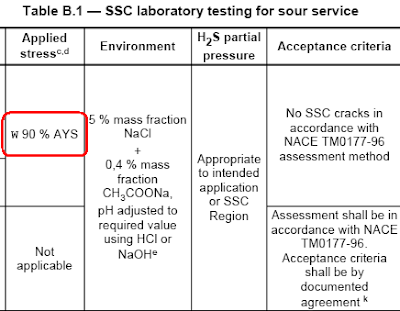
If you refer to NACE MR0175/ISO 15156-2, Table B.1 - SSC laboratory testing for sour service, column 3 "Applied Stress", you will find "w 90 % AYS". See following image.


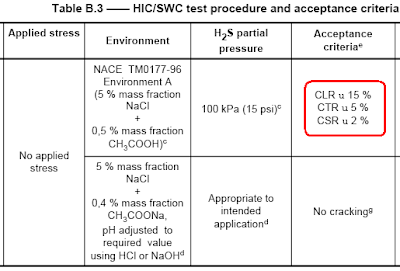
Now, refer to NACE MR0175/ISO 15156-2, Table B.3 - HIC/SWC test procedure and acceptance criteria, column 5 "Acceptance Criteria", you will find "CLR u 15 %", "CTR u 5 %" & "CSR u 2 %". See following image.


What is the meaning of
  • "w 90 % AYS"
  • "CLR u 15 %"
  • "CTR u 5 %"
  • "CSR u 2 %"
Infact these are errors in NACE MR0175 / ISO 15156-2. The"w" should be read as "≥" and "u" should be "≤". The correct text shall be
  • "≥ 90 % AYS"
  • "CLR ≤ 15 %"
  • "CTR ≤ 5 %"
  • "CSR ≤ 2 %"
Similar error occur in
  • Table A.3 in NACE MR0175 / ISO 15156-2,
  • Table, A.8, A.9, A.17, A.18, A.19...in NACE MR0175 / ISO 15156-3
Details refer to Errata in NACE MR0175 / ISO 15156.

Download.

Related Post

Monday, October 20, 2008

Guideline on Use of MR0175 / ISO15156

Display problem ? Click HERE

Recommended :
Subscribe FREE - Processing Magazine

H2S dissolved in water to form weak acid promote corrosion and form free hydrogen. Free Hydrogen will penetrate the metal, reduce ductility of metal and potentially lead to stress failure below it yield stress, results Sulphide Stress Corrosion Cracking (SSCC).

Sulfide stress corrosion cracking (SSCC) is cracking of metal involving corrosion and tensile stress (residual and/or applied) in the presence of water and H2S. SSC is a form of hydrogen stress cracking (HSC) and involves embrittlement of the metal by atomic hydrogen that is produced by acid corrosion on the metal surface. Hydrogen uptake is promoted in the presence of sulfides. The atomic hydrogen can diffuse into the metal, reduce ductility and increase susceptibility to cracking. High strength metallic materials and hard weld zones are prone to SSC.

NACE Standard MR0175 / ISO 15156 - Petroleum and Natural Gas Industries – Materials for use in H2S-containing Environments in Oil and Gas Production was established to provides limits of H2S partial pressure for precautions against sulfide stress cracking (SSC) and guidance for the selection and specification of SSC-resistant materials.

Since the released of this NACE MR0175 / ISO 15156, it has introduced a few more elements into the "sour" service criteria i.e. pH, Chloride contents, etc. This may have created some level of difficulties in understanding and usage of this standard.

Canadian Association of Petroleum Producers (CAPP) has released a document entitle "GUIDE in Use of International Standard NACE MR0175/ISO15156" to provides a supporting document, which may be used as a reference tool to :
  • provide a brief overview of the NACE / ISO publication, outlining the most significant changes and their implication to the industry,
  • provide guidance and assistance on how to apply the new publication using simple to follow flowcharts, and clarification examples,
  • provide sample forms which could be used to meet the intent of the publication.

For those engineer involved in Oil & Gas (upstream) exploration and production, this document is pretty good for understanding and reference.

Download.

Related Post