Wednesday, December 5, 2007

Requirements of SDV Bypass Pressurization Line


Shutdown valve (SDV) is commonly used in oil and gas facilities for safe and isolation to avoid escalation of hazardous material from one system to another system. It is commonly controlled by Emergency Shutdown System (ESDS) which is highly reliable system. In earlier post, i have listed 12 main features required by a Shutdown valve. Normally the Shutdown valve is maintained in open position using Instrument Air. In the event of Instrument air failure, the Shutdown valve will shut closed.

Bypass Pressurization Line
During start-up, the shutdown valve in closed position. The upstream of shutdown valve will be pressurized at high pressure (i.e 100 barg) whilst the shutdown valve may still kept at 2-3 barg. High differential pressure across the shutdown will results high torque against the actuator. It may not be cost effective and justifiable to provide an large actuator just to open the Shutdown valve. A more reasonable approach will be providing a bypass line with a small shutdown valve and a throttling valve across the main shutdown valve for initial pressurization purpose. See below image.


Shutdown Bypass Valve during Emergency

There may be an emergency situation e.g. plant fire, serious leakage, etc take place during pressurization period and demand downstream system to be isolated immediately and reliably for safety purpose, thus a the bypass valve shall be connected to the Emergency Shutdown System (ESDS) to enable proper shutdown.

Distance between Bypass Shutdown Valve and Throttling Valve
High pressure drop across the throttling valve may potential leads to very low temperature downstream of the throttling valve due to Joule-Thompson (JT) effect. The fluid temperature downstream of throttling may drops below subzero (Less than zero degree Celsius). Sensible heat in the piping will transfer to cold fluid and slowly approaching this subzero temperature. The "coldness" will travel back to upstream of throttling valve and may reaches the Shutdown valve. It potentially cause the upstream Shutdown valve body temperature drops below subzero as well. Moisture from atmosphere will freeze at the Shutdown valve body and potentially cause the stem stuck at open position. This will poses hazard to the system as the shutdown may not able to close when it is demanded. It is recommended to provide to locate throttling valve 600mm downstream of the Shutdown valve. Similar arrangement in the blowdown line.

Heat Tracing Downstream of Shutdown valve
JT effect may leads to sweating / ice form at external pipe. Application of anti-condensation coating and heat tracing on the bypass pipe will help to avoid sweating / icing.

Depends on fluid composition, low temperature may leads to hydrate formation or ice formed and potentially partially/totally block the small pressurization line. Heat tracing may help (may not avoid) keep temperature above hydrate formation temperature.

Bypass Line Size
Bypass line size is very much subject to fluid composition, downstream inventory, differential pressure, etc. The line may be sized such that the flowrate is maximum but without hydrate fromation or ice formed at reasonable pressurization time. In some event, noise level may be an issue and needs additional assessment.


Automated Pressurization
As downstream pressure slowly increases, the differential pressure will drops and lead to low flow passing the throttling valve. Operator may needs to slowly increase the opening to increase the throttling valve. Some plant imposing minimum manning and increase automation, those the opening of throttling valve may be automated with a pressure control with a bypass control valve. This type of arrangement shall be properly engineered as there are many issues such as hydrate, ice-form, noise associate with this arrangement.

Related Topic


Continue receive FREE stuff & Update.......Subscribe by Email OR RSS
Any comments / advices ?..........Drop it in comment field (below) or sent a private email to me...

Tuesday, December 4, 2007

High Pressure High Liquid Loading Distillation


Designing a distillation column with high liquid loading at high pressure system generally will encounter challenges due to

- High Liquid flowrate
- Low density difference
- Low Surface tension
- Low Separation efficiency

Downcomer design will be critical in High pressure - high liquid loading system. SULZER has presented special design considerations for above mentioned system in the AICHE annual meeting.


Except for a few odd services, high liquid rate applications are typically the domain of either trays or random packings. Aside from the distributors, random packing designs are rather straightforward with the designer choosing the proper size to accommodate the fluid flow rates and achieve the desired efficiency. Trays, on the other hand, have a large variety of adjustable parameters and can be especially complex, especially when designed for high liquid rate applications...

If you designing or operating a high pressure high liquid loading system, this paper may provides you some ideas.

Related Topic


Continue receive FREE stuff & Update.......Subscribe by Email OR RSS
Any comments / advices ?..........Drop it in comment field (below) or sent a private email to me...

Monday, December 3, 2007

Several Concerns in High CO2 Field Development

Recently I have worked on a gas field development. This field contains very high Carbon Dioxide (~ 40% CO2), reasonably high Hydrogen Sulphide (>120ppm h2S), high mercury level (> 5000 microgram/Nm3 at 25 barg) and high sand production (> 2 kg/h). As compare to other sweet field, it gave a lot of challenges to the project team from technical and commercial perspectives. This post i would focus on what are the concerns and attention to be taken on for a high CO2 gas field development.

SEVERE CORROSION
CO2 present in water saturated gas results a very corrosive environment to the material containing it. Carbon steel normally used in oil and gas expose to ~40% CO2 will experience extremely high corrosion rate and corrosion resistance material such as Stainless steel, duplex stainless steel, etc shall be used. In marine laden environment, duplex stainless steel would be required to avoid Chloride Stress Corrosion Cracking.

FLARE COMBUSTIBLE
CO2 in gas will lower the heating value of sale. It shall be removed in order to increase the value of the heating value and subsequently increase the commercial value. The CO2 gas shall be removed in Acid Gas Removal unit such as Amine absorption system, membrane separation, etc. In this plant, we have adopted the membrane separation system. The CO2 removed from gas will be disposed off via a permeate flare. The lower heating value (LHV) of permeate flare gas shall be maintained at about 200-250 BTU/ft3 (rule of thumb for normal flare tip) for proper flaring.

Apart from normal flaring, a high CO2 gas is expected relief to flare system in the event of emergency depressurization and Opening of Pressure Relief Valve with high CO2 content. Similarly, the Lower heating value (LHV) shall be more than 200-250 BTU/ft3 as rule of thumb for normal flare tip. In some cases, sonic tip is employed to shorten flare boom length and requirement of dedicated flare platform. The lower heating value (LHV) required may be as high as 800-850 BTU/ft3 as rule of thumb.

LOW LHV FUEL
Fuel gas is normal extracted from the sales gas and supply to gas turbine, furnace, flare, etc as fuel. One of the major challenges with low LHV fuel gas would be proper selection of gas turbine. Some gas turbines may not work efficiently in low LHV (high Co2) gas and selection of gas turbine is getting very critical. This especially crucial during black start-up and restart-up as very high CO2 gas (without treatment) will only be available during this period. This may leads to adoption of dual fuel (gas & diesel) gas turbine and high capital investing is required.

DISPERSION ISSUE
High CO2 gas is burnt in flare system. In the event of flare flame-off, CO2 with high molecular weight (44) is heavier than air (29) and very high potential of felt on the platform and result the instantaneous high CO2 concentration which endanger operator from suffocation. Flare boom and tip design shall ensure proper dispersion of CO2 in the event of flare flame-off.

HYDRATE FORMATION TENDENCIES
Gas with high CO2 will have higher tendencies of hydrate formation. Increases of CO2 in gas will increase the hydrate formation temperature at same pressure. Special attention shall be paid at compressor anti-surge recycle valve, air cooler, etc. Hydrate management study shall be conducted to address hydrate formation for any operating scenarios.

CO2 GAS DISPOSAL
Presently not many countries imposed CO2 capture and re-injection. This includes the project I have handled before. With increasing awareness on global warming and greenhouse effect, there are / will be many efforts like researches, seminars, conferences and general protocol i.e. Kyoto protocol to reduce above mentioned environment impacts. One of the efforts would be CO2 re-injection back to the well. Develop a high CO2 field shall take into account of capital investment of new gas injection platform and associate facilities.

Other than 6 major technical concerns that i mentioned above related to high Co2 field development, i believe there are many other issue could be important and worth for discussion. Why not you share yours ?

Related Topic


Continue receive FREE stuff & Update.......Subscribe by Email OR RSS
Any comments / advices ?..........Drop it in comment field (below) or sent a private email to me...

Wednesday, November 28, 2007

Petrol Kiosk - Some Thought and Advices...


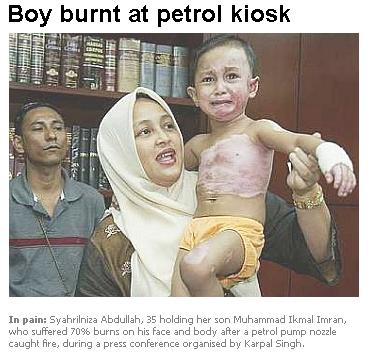
Today i read a news here "Boy burnt at petrol kiosk". Pity the boy with 70% burnt on his face and body. The victim mentioned the following :


"As I pulled the pump nozzle out from the petrol tank, it caught fire.

"Fuel was still coming out from the burning nozzle and then adik was on fire. I threw the nozzle down and started rolling him on the ground to put out the fire."

"He said he shouted for the fire extinguisher twice but it took a while for the station staff to get it as it was locked in the office. "

From the story, i have noticed two major points
  1. fire started spontaneously without any cause.
  2. fire extinguisher is locked in the office.

CAUSES
There are many causes can lead to ignition of petrol :
  • Static charge - Some clothing may easily generate static electric when people moves. It can cause petrol fume ignited.
  • Cell phone - it carry battery and may send and receive signal without people knowing. It is another potential cause ignition. This worst could be cell phone ring when you are filling the petrol. READ more HERE.
  • Fill petrol without shutting car engine - Car engine is hot and continuously generating heat. Exhaust gas is hot may poses risk of petrol ignition.
  • Smoking - This is an obvious cause. Nobody is allowed to smoke at petrol station. Sometime the problem may came from ignorance and uneducated attendant. READ more HERE.
Of course there are other factors such as material used for petrol filling nozzle, lightning protection system, emergency shutdown system, ventilation, etc


SECURITY
Fire extinguisher is meant for emergency use but yet it store and locked in the office for security reason.
  • Ignorance - The owner and attendant ignore safety rule and regulation.
  • Uneducated - Many attendant are from non-educated group. They may not aware of safety concern

ADVICES

This has triggered me to think more as we are dealing with this on daily basis.

  • Static charge - Sometime you can not avoid generation of static charge but you can "discharge" it. Touch metal or structure before you take the petrol nozzle out from the holder. It helps to discharge (partly if not fully) the static charge.
  • Cell phone - Never take the cell phone with you in the petrol station. Keep it in the car. Also don't answer any call. If possible, switch it off.
  • Fill petrol without shutting car engine - Stop the engine.
  • Smoking - I guess this is well aware by all of us but please don't ignore.
  • Locked Fire Extinguisher - i would say make a report to authority and leave it to the enforcement team. NEVER goes back to this station again.
  • Educate those you love - You are probably serving Chemical and Process or Oil and Gas community. You are partly the "expert" in front of others. Educate others...they will believe it base on your credibility.
I guess every car user like us can do above mentioned as minimum.


Continue receive FREE stuff & Update.......Subscribe by Email OR RSS
Any comments / advices ?..........Drop it in comment field (below) or sent a private email to me...

Tuesday, November 27, 2007

Useful Documents Related to Control Valve

CV

Control valve has been widely used in Chemical & Process Plant for material feeding control and operating condition control, material feeding control. Today control valve technology is highly reliability and availability and long life span. It is a very mature technology. There are many handbooks and articles available online and FREE for read and download. Out of all, i would like to highlight a few that i think they are rather complete and you shall not miss them.

FISHER CONTROL VALVE HANDBOOK
Emerson Fisher
The Control Valve Handbook is both a textbook and a reference on the strongest link in the control loop, the control valve and its accessories. This book includes extensive and proven knowledge from leading experts in the process control field including contributions from the ISA and the Crane Company...

MASONEILAN CONTROL VALVE HANDBOOK
Masoneilan
This handbook on control valve sizing is based on the use of nomenclature and sizing equations from ISA Standard S75.01 and IEC Standard 534-2. Additional explanations and supportive information are provided beyond the content of the standards...

GUIDELINES FOR APPLICATION OF CONTROL VALVES
Process Industrial Practices
In an effort to minimize the cost of process industry facilities, this Practice has been prepared from the technical requirements in the existing standards of major industrial users, contractors, or standards organizations. By harmonizing these technical requirements into a single set of Practices, administrative, application, and engineering costs to both the purchaser and the manufacturer should be reduced. While this Practice is expected to incorporate the majority of requirements of most users, individual applications may involve requirements that will be appended to and take precedence over this Practice...

VALVE SIZING & SELECTION
CheResources
Step-by-step control valve sizing method and comparison of different types of control valve as well as selection...

CONTROL VALVE TUTORIAL
Spirax Sarco
This tutorial briefly describes the basic components of different types of linear and rotary action control valves available for use in steam and water systems...

SIZING AND SELECTION OF CONTROL VALVES
Siemens
The control valve is the most important single element in any fluid handling system, because it regulates the flow of fluid to the process. To properly select a control valve, a general knowledge of the process and components is usually necessary. This reference section can help you select and size the control valve that most closely matches the process requirements. The sizing of a valve is very important if it is to render good service. If it is undersized, it will not have sufficient capacity. If it is oversized, the controlled variable may cycle, and the seat, and disc will be subject to wire drawing because of the restricted opening.

EASE CONTROL VALVE SELECTION
With so many types and options available, choosing the right control valve can seem daunting. Selection can be simplified by considering the process fluid, the service requirements, and how the various valves function.

PLANT DESIGN & CONTROL VALVE SELECTION UNDER INCREASING COST & TIME PRESSURE
Dipl. Ing. Holger Siemers, SAMSON AG
  • (Part I) - This article is split into two parts: broadly speaking, part one looks at control valve operating points and provides a case history involving a mismatch. The author introduces better valve sizing practices and uses this theory to resolve the problems introduced in the case history. Part two (scheduled for the June issue) starts by explaining the trends and definitions of inherent valve characteristics before focusing on, "quick and dirty" sizing. The paper then addresses cavitation before concluding with the expert software CONVAL to help select the optimum valve characteristic form.
  • (Part II) - Part two starts by explaining the trends and definitions of inherent valve characteristics before focusing on "quick and dirty" sizing. The paper then addresses cavitation before concluding with the expert software available to help select the optimum valve characteristic form.

CONTROL VALVE DESIGN ASPECTS FOR CRITICAL APPLICATIONS IN PETROCHEMICAL PLANTS
Dipl. Ing. Holger Siemers, SAMSON AG


  • (Part I) - This paper reviews the past, present and future of valve design and sizing, taking all-important issues such as increasing cost pressure and time pressure into account. This paper is presented in two parts: firstly, how to use manufacturer independent software to analyze given or calculated plant parameters in more detail from an overall point of view with a complete power check and optimizing possibilities. Some case studies are also discussed. The second section, scheduled for a future issue, includes information on to design, size and use severe service control valves with good performance for long maintenance intervals. Different philosophies of valve design (plug design), pressure balance systems, stem sealing, actuator sizing, cost philosophies for "high end" applications are discussed.
  • (Part II) - This section presents information on design, size and use of severe service control valves, the kind of troubles that can be predicted with control valve sizing as well as suggestions for troubleshooting control valve failures.

VALVE SIZING & SELECTION TECHNICAL REFERENCE
WARREN CONTROLS
A Control Valve performs a special task, controlling the flow of fluids so a process variable such as fluid pressure, fluid level or temperature can be controlled. In addition to controlling the flow, a control valve may be used to shut off flow. A control valve may be defined as a valve with a powered actuator that responds to an external signal. The signal usually comes from a controller. The controller and valve together form a basic control loop. The control valve is seldom full open or closed but in an intermediate position controlling the flow of fluid through the valve. In this dynamic service condition, the valve must withstand the erosive effects of the flowing fluid while maintaining an accurate position to maintain the process variable.

WELKER JET CONTROL VALVE - A PRACTICAL APPLICATION HANDBOOK
Welker Eng
The current Welker Jet® and the earlier Jet Stream™ Control Valves are the most unique Control Valves on the market today. Over the last 44 years, Welker employees have discussed the Jet with thousands of people and users in over 15 countries worldwide. Because of its unique features and unparalleled performance, much has been said and misunderstood about this product. In an attempt to clarify some of these statements and to share the accumulated "pearls of wisdom" that have been recorded over the years, this handbook has been assembled. A full understanding of the Jet, will give the engineer, designer, operations personnel and technician a greater appreciation for the features that the Jet presents and the performance that can be expected. The Jet can solve many problems that otherwise would create additional engineering and cost for the gas company.

FAQ Related to Control Valves
Besides theory and practical knowledge in articles, there are still many frequently asked questions related to control valve. Following is a list of frequently asked question (FAQ) related to control valve. It is pretty useful especially to young engineer.


MY WISH...
I have received number of emails from sincere reader of this blog. Large percentage are came from young and dynamic engineers. They are willing to learn and contribute within our community. Above is only part of many that i think are useful for a young engineers. I hope you may learn from them. Also if you know any that is useful...please let me know. I will pack here for the benefits of all...

(updated on Feb 07, 2008)

Related Topic


Continue receive FREE stuff & Update.......Subscribe by Email OR RSS
Any comments / advices ?..........Drop it in comment field (below) or sent a private email to me...

Saturday, November 24, 2007

Final Compilation...

Beautiful_scenery1

Finally i have completed my compilation of previous posts... For those who has not read my previous posts, you may enjoy reading them now.

CATEGORY sort by ALPHABET & CATEGORY

POST per CATEGORY sort by ALPHABET A
POST per CATEGORY sort by ALPHABET B
POST per CATEGORY sort by ALPHABET C
POST per CATEGORY sort by ALPHABET D
POST per CATEGORY sort by ALPHABET E
POST per CATEGORY sort by ALPHABET F
POST per CATEGORY sort by ALPHABET G
POST per CATEGORY sort by ALPHABET H
POST per CATEGORY sort by ALPHABET I
POST per CATEGORY sort by ALPHABET J
POST per CATEGORY sort by ALPHABET L
POST per CATEGORY sort by ALPHABET M (updated Nov 24, 2007)
POST per CATEGORY sort by ALPHABET N (updated Nov 24, 2007)
POST per CATEGORY sort by ALPHABET O (updated Nov 24, 2007)
POST per CATEGORY sort by ALPHABET P (updated Nov 24, 2007)
POST per CATEGORY sort by ALPHABET R (updated Nov 24, 2007)
POST per CATEGORY sort by ALPHABET S (updated Nov 24, 2007)
POST per CATEGORY sort by ALPHABET T (updated Nov 24, 2007)
POST per CATEGORY sort by ALPHABET U (updated Nov 24, 2007)
POST per CATEGORY sort by ALPHABET V (updated Nov 24, 2007)
POST per CATEGORY sort by ALPHABET W (updated Nov 24, 2007)
POST per CATEGORY sort by ALPHABET Y (updated Nov 24, 2007)


Continue receive FREE stuff & Update.......Subscribe by Email OR RSS
Any comments / advices ?..........Drop it in comment field (below) or sent a private email to me...

Thursday, November 22, 2007

Two Most Important Articles for Heuristic in Chemical Engineering

Display problem ? Click HERE


Heuristic is method, tricks & tips that common used to helps in approaching a problem. It is a compilation of knowledges and experiences by most (if not all) individual. It helps to tackle problem in a simple, reasonable and generally optimized ways and to avoid repetitive common failure.

Similar to other sectors and disciplines, most credible Chemical and Process Engineers have put a lot of efforts in compilation of their knowledges, experiences, etc and produced Heuristic dedicated to Chemical & Process Engineering...

In my process design career, i have found two most credible and reliable Heuristic in Chemical & Process Engineering.

Heuristic2

"Although experienced engineers know where to find information and how to accurate computations, they also keep a minimum body of information in mind on the ready, made up largely of shortcuts and heuristics. the present compilation may fit into such a minimum body of information, as boost to memory or extension in some instances into less often encountered areas."

Heuristic1

"Experience is typically what turns a good engineer into a greater engineer. An engineer that can look at a pipe and a flowmeter and guess the pressure drop within 5%. Someone who can at least estimate the size of a vessel without doing any calculations. When I think of such rules, two authors come to my mind, Walas and Branan. Dr. Walas' book, Chemical Process Equipment: Selection and Design has been widely used in the process industry and in chemical engineering education for years. Mr. Branan has either helped write or edit numerous books concerning this topic. Perhaps his most popular is Rules of Thumb for Chemical Engineers. areas."

These articles are available FREE for all in our community. If you don't aware of these articles, please read them. I am sure that you will benefits in the future Chemical & Process Engineering career.

My 2-cents advice
One shall always keep in mind that these articles are the best effort by most credible engineers. The heuristic and recommended rule of thumbs are experience and case specific. It is NOT some compulsory rule that we needs to comply to. It provides guideline to approach problem but engineering judgment and detailed calculation and design shall be conducted for final confirmation.

Last but not least, please rate this article and provide your valuable comments. Your 10 second of effort worth million to me...

Further Reading :


Continue receive FREE stuff & Update.......Subscribe by Email OR RSS
Any comments / advices ?..........Drop it in comment field (below) or sent a private email to me...