Showing posts with label Ebook. Show all posts

Sunday, July 11, 2010

Free "Introduction to Heat Transfer" Ebook

Recommended :

It is often found necessary to transfer heat form hot to cold fluids by means of heat exchangers. there is wide variety of equipment available for this purpose, although in this Engineering Design Guide discussion is restricted to the more common types (other heat exchangers being mentioned only in passing). The very important aspect of removing heat from a primary source, such as a fired heater or the fuel elements of a nuclear reactor, also falls outside the scope of this guide. Although sufficient information is provided to enable the reader to understand and deal with simple heat transfer problems, this text to a large extend serve as an introduction to the more specialized books to which reference is made...


This FREE HEAT TRANSFER ebook discusses on several topics related to heat transfer and heat exchange. It content cover the general problem of heat exchange, analysis of heat conduction, convective heat transfer, thermal radiation heat transfer, mass transfer, etc

Download
Source : http://www.hts.org.uk/
Thanks to D. Butterworth

Related Post

Thursday, September 25, 2008

Chemical Hazard Analysis Procedures Handbook

Display problem ? Click HERE

Handbook of Chemical Hazard Analysis Procedures has objectives to expand Technical Guidance on Hazards Analyzes document by including information for explosive, flammable, reactive and otherwise dangerous chemicals. It also aimed to focus on a specifics initial list of acutely toxic chemicals (referred to as Extremely Hazardous Substances) due to their high inhalation toxicity when airborne.

Recommended :
- Subscribe FREE - Chemical Engineering
- Tips on Succession in FREE Subscription

This handbook provides methods to investigate local hazards in greater detail than permitted by earlier guidance, results of calculations using air dispersion models may differ. Continuous evaluation of types of models and others to determine the degree of Impact on calculations concerning the consequences of a chemical release.

Beyond providing additional methodologies for assessing the potential impact of hazardous material releases, thss handbook also expands the three-step hazards analysis approach which includes hazard identification, vulnerability analysis, and risk analysis.

If you are plant manager or engineers greatly dealing with a lot of chemicals, this would be a great handbook for you.

Click here to read this handbook. You may also download this handbook.

Related Posts

Saturday, September 6, 2008

An Introduction to Oil & Gas Production...

Display problem ? Click HERE

Recommended :
- Subscribe FREE - Chemical Processing
- Tips on Succession in FREE Subscription

Oil has been used for lighting purposes for many thousand years. In areas where oil is found in shallow reservoirs, seeps of crude oil or gas may naturally develop, and some oil could simply be collected from seepage or tar ponds. Historically, we know of tales of eternal fires where oil and gas seeps would ignite and burn. One example 1000 B.C. is the site where the famous oracle of Delphi would be built, and 500 B.C. Chinese were using natural gas to boil water. But it was not until 1859 that "Colonel" Edwin Drake drilled the first successful oil well, for the sole purpose of finding oil.


Oil & Gas Production Handbook

There are much of equipment described in standards, equipment manuals and project documentation, however, material to quickly provide reader an overview of the entire upstream area found to be pretty minimum. This is a handbook been compiled to provide readers with an interested in the oil and gas production industry an overview of the main processes and equipment. Above handbook will also provides enough detail to let the engineer get an appreciation of the main characteristics and design issues.,

Download (Click HERE)

Related Posts

Tuesday, July 15, 2008

Compressed Gas Incident - Awareness & Learning Fundamentals...

Display problem ? Click HERE


Recommended :
Subscribe FREE - Processing Magazine


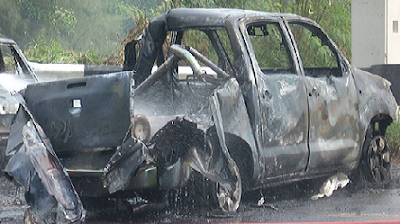
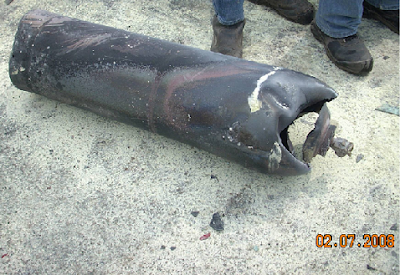
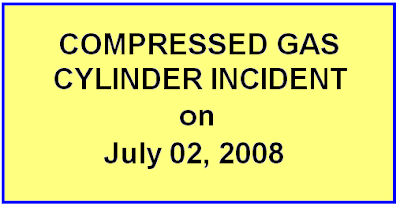
There was an incident happened recently near a factory involved 3 cars on the roads. A small truck carried 2 Acetylene gas cylinders and 2 Oxygen gas cylinder at the back caught fire in the middle of road. The cylinder on fire flew like a bullet, hit at first car, penetrated the car roof and final stopped after hit at second car front bumper. No details revealed...


Following are some photos captured for view :
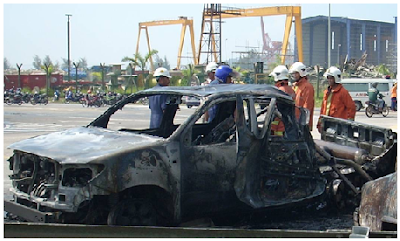


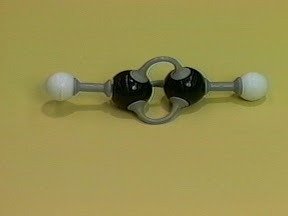
Acetylene (IUPAC name: ethyne) , C2H2, is a unstable and unsaturated triple bonded hydrocarbon in gas form. It common store as compressed gas in cylinder. Similarly an Oxygen cylinder is compressed oxygen store in cylinder. Acetylene and Oxygen are commonly used for welding (known as Oxy-acetylene welding), cutting, heat treatment and coating. As the car carried Acetylene & Oxygen gas cylinder, it is obvious that the owner use them for welding and cutting purpose.


Recommended :
Subscribe FREE - Chemical Processing

A simple Material Safety Datasheet (MSDS) for Acetylene is located here (click here). From the MSDS, acetylene is extremely flammable (low flash point) and explosive. IT MAY DECOMPOSE VIOLENTLY IN ITS FREE STATE UNDER PRESSURE IN EXCESS OF 15 PSIG.

Following is a video clip shows you how "explosive" is if Acetylene mix with Oxygen.
(If you can not view the video clip, click here to view via browser)


How "explosive" is if Acetylene mix with Oxygen

If you or your operators are handling compressed gas i.e. Acetylene, Oxygen, Nitrogen, etc, be sure you and your operators are well aware of the properties of the gases, the way to handle, transport and operate them in the safe manner. Following are collection of article that helps you to educate yourself or your operators :

Gas Cylinder Awareness Outline
The purpose of this awareness training is to help staff and students understand how compressed gas cylinders (CGC) work and how to handle them safely. The training should address the following objectives:
  • Understand the inherent dangers of compressed gas cylinders
  • Look to hazard labels, warning signs and MSDS for important information
  • Selection of appropriate PPE when working with gas cylinders
  • Know how to properly move, handle and store cylinders
  • Know what to do in case the cylinder or delivery system develops a leak (e.g., trouble-shooting and emergency procedures)
  • Know what problems can occur when installing a cylinder in a gas delivery system (e.g., installing a regulator on a cylinder)
  • Know how to check cylinders for potential problems
2.02 Compressed Gas Cylinder Program
This program contains requirements for practices designed and implemented to protect University employees from the hazards of compressed gases as identified by the University and as defined by OSHA in 29 CFR 1910, the National Fire Protection Association (NFPA) and the Compressed Gas Association (CGA).

Gas Cylinder Safety
A brief discussion on grades of gases, normal storage pressure, type of fitting and regulators used, transportation, storage, how to keep safe of compressed gases, problems related to regulators, information on fire and other aspect.

Gas Cylinder Handling & Storage
Gas cylinders are constructed and maintained in accordance with regulations of the Department of Transportation (DOT). The purchaser should make sure all cylinders bear DOT specification markings, and the contents should be legibly marked on each cylinder in large letters....

Compressed Gas Cylinder Storage and Handling
Compressed gas cylinders are used in many workplaces to store gases that vary from extremely flammable (acetylene) to extremely inert (helium). Many compressed gas cylinders are stored at extremely high pressures (up to 2,500 pounds per square inch gauge or PSIG). A sudden release of these gases can cause a cylinder to become a missile-like projectile. Cylinders have been known to penetrate concrete-block walls. If handled properly compressed gas cylinders are safe. If handled improperly, the same cylinders can present a severe hazard to you and the surrounding area.

Guidelines for Gas Cylinders
This document is an advisory text which sets out general guidelines for the safe storage and handling of gas cylinders. Further information may be obtained from the documented references and the Heath, Safety & Environment Unit. Gas cylinders are used in many University work areas. Approved methods of handling, storage and transport will ensure safe use by the University staff and contractors.

Acetylene, the Principles of Its Generation and Use
A practical handbook on the production, purification and subsequent treatment of Acetylene for the development of light, heat and power.

Take care with acetylene
This leaflet is for people who use acetylene for welding, cutting and similar processes. It provides information on the fire and explosion hazards of acetylene.

Acetylene Safety Alert
The following safety alert was provided to Dynamic Industries, Inc. by one of our clients and did not occur on any of our projects or work sites. However, we should be aware of the hazards associated with the use of acetylene due to the work processes in which peform do on a daily basis.

Compressed Gas Leak Procedure
Use the following recommended procedures if leaks are detected on compressed gas cylinders or in gas supply systems.

The Beginners Guide to Oxy-Acetylene Welding Equipment
The purpose of this page is to introduce the beginning welder to the equipment used in the Oxy-Acetylene welding process. This will be done starting with the cylinders and ending with the torch tip.

Related Post

Saturday, June 7, 2008

3 Most Important & FREE Magazines That I Read...

Display problem ? Click HERE

Every practising engineer is encourage learn to fulfill the basic requirement as practising engineer and further develop himself/herself as professional engineer. One of the way to continue learning and further development is to read reputable magazines to keep themselves up-to-date with latest technology, practices, lesson learnt, others experiences, new concept, etc.

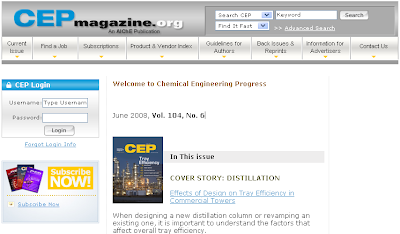
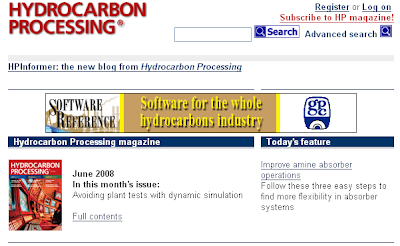
Being a professional engineer (PE) for many years in Chemical & Process and Oil & gas field, three reputable magazines which i continue reading and update myself without fail. There are Chemical Engineering Progress (CEP), Chemical Engineering (CE) magazine and Hydrocarbon Processing (HP).


Chemical Engineering Progress (CEP)
Chemical Engineering Progress (CEP) is one of the main publication of the American Institute of Chemical Engineers (AIChE), one of the world's leading organization for chemical engineers. 85% of the readers work in industry and remaining from academia and government.


CEP publishes articles on few key aspects of chemical engineering :
  • Career Development
  • Environmental Management
  • Fuels and Energy
  • Fluids and/or Solids Handling
  • Information Technology
  • Management
  • Materials
  • Measurement and Control
  • Reactions and Separations
  • Safety
You may subscribe to CEP magazine by click HERE. If you are the members of AICHE, you will receive a FREE copy of CEP. In additional, you may read the previous issue backdated to 2001.

Check out latest CEP content...Click HERE


Chemical Engineering (CE)
Chemical Engineering serves chemical engineering professionals in the chemical process industry including manufacturing, engineering, production, etc. Chemical Engineering is published monthly by Access Intelligence, primarily for chemical engineers and related technical people in the chemical process industries (CPI), as well as at engineering, design and construction companies that serve the CPI.

The Chemical Engineering magazine is not funded by any organization but supported by subscription and advertisement. Nevertheless, Chemical Engineering also fulfilling Chemical Engineering Society mandate and responsibility by offering FREE (latest) issue to all qualified professional (presently). Please take your quick action while it is still available.

CLICK HERE (SUBSCRIBE) to qualify yourself for FREE Chemical Engineering (CE).


Hydrocarbon Processing (HP)
Hydrocarbon Processing, one of the premier magazine providing job-help information to technical and management personnel in petroleum refining, gas processing, petrochemical/chemical and engineer/constructor companies throughout the world – since 1922.

Similar to Chemical Engineering, Hydrocarbon Processing (HP) also fulfilling Oil & Gas society mandate and responsibility by offering FREE (latest) issue to all qualified professional (presently). Please take your quick action while it is still available.

CLICK HERE (SUBSCRIBE) to qualify yourself for FREE Hydrocarbon Processing (HP)

Related Post

Friday, May 30, 2008

Non - Technical Quick References for a Chemical & Process Engineers

Display problem ? Click HERE


Chemical & Process Engineer regardless serving design or operation, activities such as calculation, presentation, data collection, analysis and management, etc, have become a common daily activities. Several tools such as Excel, Powerpoint, Outlook, Lotus notes, etc are commonly use to accelerate these activities and enhance performance.


CustomGuide founded in the 1990s by a group of instructors and has become one of the world's leader for customizable computer training and assessments. CustomGuide offers computer training course, reading material, online learning, skills assessment demons and customized computer training. Those training courses includes all tools as mentioned above.

Apart, CustomGuide offers FREE references for these tools. You may download as you wish :

Microsoft FrontPage
Microsoft Office
Internet Explorer Microsoft Project
Microsoft SharePoint
Microsoft Visio
BELOW are for MAC users

Apple Appleworks

Tuesday, April 1, 2008

Instrumentation and Formulae & Conversion...

Display problem ? Click HERE


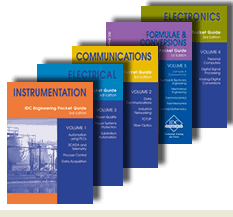
IDC-Online has made available Engineering Pocket Guides FREE for download... They consist of Instrumentation, Data Communications, Electrical Engineering, Electronic Engineering and Formulae & Conversion. The most interesting to a Chemical and Process engineer would be the Instrumentation and Formulae & Conversion.

To obtain a copy, your may just to provide First name, Last name, Email Address and Country. Click here to reach IDC-Online Engineering Pocket Guideline.

Related Topic

Continue receive FREE stuff & Update.......Subscribe by Email OR RSS
Any comments / advices ?..........Drop it in comment field (below) or send a private email to me...

Wednesday, February 6, 2008

WELKER Jet Contorl Valve Handbook


Display problem ? Click HERE

CV

With the advise from Kent (thanks), i have just included the following document link in the Useful Documents Related to Control Valve (click HERE).


WELKER JET CONTROL VALVE - A PRACTICAL APPLICATION HANDBOOK
Welker Eng
The current Welker Jet® and the earlier Jet Stream™ Control Valves are the most unique Control Valves on the market today. Over the last 44 years, Welker employees have discussed the Jet with thousands of people and users in over 15 countries worldwide. Because of its unique features and unparalleled performance, much has been said and misunderstood about this product. In an attempt to clarify some of these statements and to share the accumulated...READ MORE...CLICK HERE...

If you have any good articles (or links) that you think is interesting, please drop me a note.


Continue receive FREE stuff & Update.......Subscribe by Email OR RSS
Any comments / advices ?..........Drop it in comment field (below) or send a private email to me...

Monday, January 21, 2008

Useful Documents Related to Control Valve - Updated


Displayed problem ?
Click HERE

CV

In earlier post "Useful Documents Related to Control Valve" there are number very useful documents related control valves.

There are two good articles have been added in the same post.

PLANT DESIGN & CONTROL VALVE SELECTION UNDER INCREASING COST & TIME PRESSURE
Dipl. Ing. Holger Siemens
Samson AG
This article is split into two parts: broadly speaking, part one looks at control valve operating points and provides a case history involving a mismatch. The author introduces better valve sizing practices and uses this theory to resolve the problems introduced in the case history. Part two (scheduled for the June issue) starts by explaining the trends and definitions of inherent valve characteristics before focusing on, "quick and dirty" sizing. The paper then addresses cavitation before concluding with the expert software CONVAL to help select the optimum valve characteristic form. Part two starts by explaining the trends and definitions of inherent valve characteristics before focusing on "quick and dirty" sizing. The paper then addresses cavitation before concluding with the expert software available to help select the optimum valve characteristic form.

CONTROL VALVE DESIGN ASPECTS FOR CRITICAL APPLICATIONS IN PETROCHEMICAL PLANTS
Dipl. Ing. Holger Siemens
Samson AG

This paper reviews the past, present and future of valve design and sizing, taking all-important issues such as increasing cost pressure and time pressure into account. This paper is presented in two parts: firstly, how to use manufacturer independent softwre to analyze given or calculated plant parameters in more detail from an overall point of view with a complete power check and optimizing possibilities. Some case studies are also discussed. The second section, scheduled for a future issue, includes information on to design, size and use severe service control valves with good performance for long maintenance intervals. Different philosophies of valve design (plug design), pressure balance systems, stem sealing, actuator sizing, cost philosophies for "high end" applications are discuss. The second and third sections presents information on design, size and use of severe service control valves, the kind of troubles that can be predicted with control valve sizing as well as suggestions for troubleshooting control valve failures.

VALVE SIZING & SELECTION TECHNICAL REFERENCE
Warren Controls
A Control Valve performs a special task, controlling the flow of fluids so a process variable such as fluid pressure, fluid level or temperature can be controlled. In addition to controlling the flow, a control valve may be used to shut off flow. A control valve may be defined as a valve with a powered actuator that responds to an external signal. The signal usually comes from a controller. The controller and valve together form a basic control loop. The control valve is seldom full open or closed but in an intermediate position controlling the flow of fluid through the valve. In this dynamic service condition, the valve must withstand the erosive effects of the flowing fluid while maintaining an accurate position to maintain the process variable.

Click HERE to revisit the original post.

Related Topic

Continue receive FREE stuff & Update.......Subscribe by Email OR RSS
Any comments / advices ?..........Drop it in comment field (below) or send a private email to me...

Thursday, December 13, 2007

R&D engineer, Academician and Student...Don't miss this !


As usual, i read through most of the important website and blog news related to Oil & Gas and Chemical & Process discipline. One of the blog i found years ago and i think a Research and Development engineer and Academician should not miss is Anne Marie's Chemistry Blog, a blog maintain by Anne (read about Annie HERE).

Her blog has a lot of good information related to pure Chemistry. For example

- Periodic Table of the Elements
- Chemistry Glossary and Dictionary
- Science Pictures & Chemical Structures
- Chemistry Problems
- Teach Yourself Chemistry

From one of her post, she has shared a very useful e-book.


"The Golden Book of Chemistry Experiments, written by Robert Brent and illustrated by Harry Lazarus, was a book published in the 1960s that was intended to explain to kids how they could set up a home chemistry lab and conduct simple experiments. Supposedly only 126 copies of this book exist in libraries worldwide. Sometimes you can find a copy on eBay for around $600-$700..."

Some of you are Researcher, Academician and Student. I am sure it will benefit you...
Quick...don't miss the opportunity and offer by Anne.

Related Topic


Continue receive FREE stuff & Update.......Subscribe by Email OR RSS
Any comments / advices ?..........Drop it in comment field (below) or sent a private email to me...

Tuesday, November 27, 2007

Useful Documents Related to Control Valve

CV

Control valve has been widely used in Chemical & Process Plant for material feeding control and operating condition control, material feeding control. Today control valve technology is highly reliability and availability and long life span. It is a very mature technology. There are many handbooks and articles available online and FREE for read and download. Out of all, i would like to highlight a few that i think they are rather complete and you shall not miss them.

FISHER CONTROL VALVE HANDBOOK
Emerson Fisher
The Control Valve Handbook is both a textbook and a reference on the strongest link in the control loop, the control valve and its accessories. This book includes extensive and proven knowledge from leading experts in the process control field including contributions from the ISA and the Crane Company...

MASONEILAN CONTROL VALVE HANDBOOK
Masoneilan
This handbook on control valve sizing is based on the use of nomenclature and sizing equations from ISA Standard S75.01 and IEC Standard 534-2. Additional explanations and supportive information are provided beyond the content of the standards...

GUIDELINES FOR APPLICATION OF CONTROL VALVES
Process Industrial Practices
In an effort to minimize the cost of process industry facilities, this Practice has been prepared from the technical requirements in the existing standards of major industrial users, contractors, or standards organizations. By harmonizing these technical requirements into a single set of Practices, administrative, application, and engineering costs to both the purchaser and the manufacturer should be reduced. While this Practice is expected to incorporate the majority of requirements of most users, individual applications may involve requirements that will be appended to and take precedence over this Practice...

VALVE SIZING & SELECTION
CheResources
Step-by-step control valve sizing method and comparison of different types of control valve as well as selection...

CONTROL VALVE TUTORIAL
Spirax Sarco
This tutorial briefly describes the basic components of different types of linear and rotary action control valves available for use in steam and water systems...

SIZING AND SELECTION OF CONTROL VALVES
Siemens
The control valve is the most important single element in any fluid handling system, because it regulates the flow of fluid to the process. To properly select a control valve, a general knowledge of the process and components is usually necessary. This reference section can help you select and size the control valve that most closely matches the process requirements. The sizing of a valve is very important if it is to render good service. If it is undersized, it will not have sufficient capacity. If it is oversized, the controlled variable may cycle, and the seat, and disc will be subject to wire drawing because of the restricted opening.

EASE CONTROL VALVE SELECTION
With so many types and options available, choosing the right control valve can seem daunting. Selection can be simplified by considering the process fluid, the service requirements, and how the various valves function.

PLANT DESIGN & CONTROL VALVE SELECTION UNDER INCREASING COST & TIME PRESSURE
Dipl. Ing. Holger Siemers, SAMSON AG
  • (Part I) - This article is split into two parts: broadly speaking, part one looks at control valve operating points and provides a case history involving a mismatch. The author introduces better valve sizing practices and uses this theory to resolve the problems introduced in the case history. Part two (scheduled for the June issue) starts by explaining the trends and definitions of inherent valve characteristics before focusing on, "quick and dirty" sizing. The paper then addresses cavitation before concluding with the expert software CONVAL to help select the optimum valve characteristic form.
  • (Part II) - Part two starts by explaining the trends and definitions of inherent valve characteristics before focusing on "quick and dirty" sizing. The paper then addresses cavitation before concluding with the expert software available to help select the optimum valve characteristic form.

CONTROL VALVE DESIGN ASPECTS FOR CRITICAL APPLICATIONS IN PETROCHEMICAL PLANTS
Dipl. Ing. Holger Siemers, SAMSON AG


  • (Part I) - This paper reviews the past, present and future of valve design and sizing, taking all-important issues such as increasing cost pressure and time pressure into account. This paper is presented in two parts: firstly, how to use manufacturer independent software to analyze given or calculated plant parameters in more detail from an overall point of view with a complete power check and optimizing possibilities. Some case studies are also discussed. The second section, scheduled for a future issue, includes information on to design, size and use severe service control valves with good performance for long maintenance intervals. Different philosophies of valve design (plug design), pressure balance systems, stem sealing, actuator sizing, cost philosophies for "high end" applications are discussed.
  • (Part II) - This section presents information on design, size and use of severe service control valves, the kind of troubles that can be predicted with control valve sizing as well as suggestions for troubleshooting control valve failures.

VALVE SIZING & SELECTION TECHNICAL REFERENCE
WARREN CONTROLS
A Control Valve performs a special task, controlling the flow of fluids so a process variable such as fluid pressure, fluid level or temperature can be controlled. In addition to controlling the flow, a control valve may be used to shut off flow. A control valve may be defined as a valve with a powered actuator that responds to an external signal. The signal usually comes from a controller. The controller and valve together form a basic control loop. The control valve is seldom full open or closed but in an intermediate position controlling the flow of fluid through the valve. In this dynamic service condition, the valve must withstand the erosive effects of the flowing fluid while maintaining an accurate position to maintain the process variable.

WELKER JET CONTROL VALVE - A PRACTICAL APPLICATION HANDBOOK
Welker Eng
The current Welker Jet® and the earlier Jet Stream™ Control Valves are the most unique Control Valves on the market today. Over the last 44 years, Welker employees have discussed the Jet with thousands of people and users in over 15 countries worldwide. Because of its unique features and unparalleled performance, much has been said and misunderstood about this product. In an attempt to clarify some of these statements and to share the accumulated "pearls of wisdom" that have been recorded over the years, this handbook has been assembled. A full understanding of the Jet, will give the engineer, designer, operations personnel and technician a greater appreciation for the features that the Jet presents and the performance that can be expected. The Jet can solve many problems that otherwise would create additional engineering and cost for the gas company.

FAQ Related to Control Valves
Besides theory and practical knowledge in articles, there are still many frequently asked questions related to control valve. Following is a list of frequently asked question (FAQ) related to control valve. It is pretty useful especially to young engineer.


MY WISH...
I have received number of emails from sincere reader of this blog. Large percentage are came from young and dynamic engineers. They are willing to learn and contribute within our community. Above is only part of many that i think are useful for a young engineers. I hope you may learn from them. Also if you know any that is useful...please let me know. I will pack here for the benefits of all...

(updated on Feb 07, 2008)

Related Topic


Continue receive FREE stuff & Update.......Subscribe by Email OR RSS
Any comments / advices ?..........Drop it in comment field (below) or sent a private email to me...