Showing posts with label Heat Transfer. Show all posts

Sunday, July 11, 2010

Free "Introduction to Heat Transfer" Ebook

Recommended :

It is often found necessary to transfer heat form hot to cold fluids by means of heat exchangers. there is wide variety of equipment available for this purpose, although in this Engineering Design Guide discussion is restricted to the more common types (other heat exchangers being mentioned only in passing). The very important aspect of removing heat from a primary source, such as a fired heater or the fuel elements of a nuclear reactor, also falls outside the scope of this guide. Although sufficient information is provided to enable the reader to understand and deal with simple heat transfer problems, this text to a large extend serve as an introduction to the more specialized books to which reference is made...


This FREE HEAT TRANSFER ebook discusses on several topics related to heat transfer and heat exchange. It content cover the general problem of heat exchange, analysis of heat conduction, convective heat transfer, thermal radiation heat transfer, mass transfer, etc

Download
Source : http://www.hts.org.uk/
Thanks to D. Butterworth

Related Post

Saturday, August 15, 2009

Estimating Heat Loss from Buried Pipe

Display problem ? Click HERE

Recommended :
- Subscribe FREE - Chemical Processing
- Tips on Succession in FREE Subscription

Plant in country experience subzero ambient temperature, one of the common natural phenomenon is increased heat loss from piping to ambient lead to low temperature fluid. Low temperature fluid will results fluid characteristic change i.e. low reactivity, increased viscosity, promote freezing, crystallization, etc and subsequently lead to several problem such as low productivity, high pressure drop, blockage, scaling, fouling, etc. It is important to design plant system to minimize heat loss to ambient.

Water system at subzero may freeze and lead to blockage and potentially cause pipe damage. One of the effective and non-costly method is utilize low conductivity of soil to reduce heat to ambient by burying water pipe. This may involve a typical heat loss calculation.


Above image is a typical buried pipe in soil.
Heat loss,
Q = S x Km x (T1 - T2)

with Shape factor S
S = 2 x PI x L / Ln [ 4 z / D ]

where
Q = heat loss from pipe, W
S = Shape factor, m
Km = Average soil conductivity, W/m-K
T1 = Pipe skin temperature, degC (or K)
T2 = Soil surface temperature, degC (or K)
PI = 3.141592654
L = Buried pipe length, m
z = Distance between the ground surface and the center of the buried pipe, m
D = Outside diameter, m

Above equations are applicable when L is large compare to D and z is larger than 1.5D.

Example
A 30m long 100mm diameter hot water pipe of district heating system is buried in the soil 500mm below the ground surface (from pipe center line). Ground surface exposing wind chilling is 10 degC whilst pipe pipe skin temperature is expected to be 80 degC. Determine heat loss from pipe if soil average conductivity is about 0.9 W/m-K.

Km = 0.9 W/m-K
T1 = 80 degC
T2 = 10 degC
PI = 3.141592654
L = 30 m
z = o.5 m
D = 0.1 m

L is much larger than D and z = 0.5 larger than 1.5(0.1) = 0.15
Above equations may be used.

Shape factor,
S = 2 x PI x L / Ln [ 4 z / D ]
S = 2 x PI x 30 / Ln [ 4 x 0.5 / o.1 ]
S = 62.9 m

Heat loss,

Q = S x Km x (T1 - T2)
Q = 62.9 x 0.9 x (80 - 10)
Q = 3963 W

Ref : Section 3-7, Heat Transfer A Practical Approach by Yunus A. Cengel, 2nd Ed.


**********************************

Above equations have been programmed by Ankur, a experience Chemical Engineer, share with readers of Chemical and Process Technology. You may download here.

Thanks to Ankur
Download

*If you have any useful program and would like to share within our community, please send to me.

Related Topics

Sunday, August 24, 2008

Webinar for Optimum Heat Transfer by Thermal Fluid

Display problem ? Click HERE

Recommended :
- Subscribe FREE - Chemical Processing
- Tips on Succession in FREE Subscription

Heating system is one of the common utilities in a gas processing, LNG production, refining plant, etc. Heating medium commonly used are Heating oil, thermal fluid, water, etc. In circulating thermal-fluid heating systems, the heat transfer rate is typically controlled to maintain a desired outlet-temperature setpoint of the fluid. However, it is the temperature of the fluid film in contact with the heater walls instead of bulk fluid temperature that often is the key factor affecting fluid life, system fouling, and overall equipment performance.

CE and Solutia are organizing a webinar on Heat Flux & Film Temperature. The webinar presenter is Robert Pelini, P.E., President of RGP Engineering, LLC. who has more than 24 years experience in the design of fired heaters and heat recovery systems and has authored numerous technical articles and
publications on process equipment and energy systems design.
The webinar will discuss :
  • The importance of fluid film temperature
  • Variables that affect film temperature, with specific emphasis on heat flux at the metal surfaces
  • Various types of fired and electric thermal fluid heater designs and estimation of their heat flux rates
  • Heat flux rates in convective thermal fluid heaters
  • How to estimate or check peak fluid film temperature
  • Common problems and how to avoid them
Related Topics

Wednesday, August 20, 2008

Few Tips on Energy Efficient & Recovery

Display problem ? Click HERE


As the price of electricity, natural gas and other fossil fuels continues to climb, chemical processors are more closely examining high-temperature operations and heat-transfer systems to see if more efficiency can be had. In many cases
it can, and, as a result, heat-transfer projects are not only justifiable, but downright attractive.

There was a dialog among a few heat exchanger specialist from Alfa Laval, Paul Muller, Exergy LLC, etc. The dialog mainly discussed on strategy to improve heat transfer efficiency, heat recovery and efficient process control during this high energy price arena.

A few tips have been present :
  • The energy crisis results high prices all of the time shorten paybacks. Energy efficient is one of the way to minimize cost
  • Energy efficient heat transfer equipment such as Plate Heat exchanger, Gasketed Heat exchanger, Bonded Heat exchanger, etc is one of the option.
  • For a service using Shell & Tube (S&T), the overall heat transfer coefficient (HTC) is around 300 Btu/h ft2°F. However, the overall heat transfer coefficient (HTC) for a compact heat exchanger can be improved 3-4 times (~1000 to 12000 Btu/h ft2°F).
  • With lower overall heat transfer coefficient, this may translate into less space, smaller installation and handling cost. Capital cost may not be low as the fabrication cost for compact heat exchanger is high.
  • Gasketed Heat exchanger good for maintenance. However shall take additional attention on the compatibility between gasket and fluid.
  • All welded or Bonded heat exchanger may be considered if there is gasket & fluid compatible problem
  • For laminar flow, heat transfer rate is only the function of fluid thermal conductivity. Operate heat transfer equipment at lamina flow during turndown could significantly reduce it heat transfer rate
  • Compact heat exchanger promote turbulence. High turbulence increase heat transfer rate and reduce fouling (read more)
  • Thus plant releasing hot exhaust gas from burner, boiler, gas turbine, etc to atmosphere may take the opportunity to recover heat
  • Improve temperature control in process system would reduce energy usage
Download details discussion...Registered CE subscriber only
Not a CE subscriber... click here to subscribe FREE Chemical Engineering (CE)

Related Topic

Monday, June 23, 2008

FAYF - Dehumidification

Display problem ? Click HERE


Recommended :
Subscribe FREE - Chemical Processing

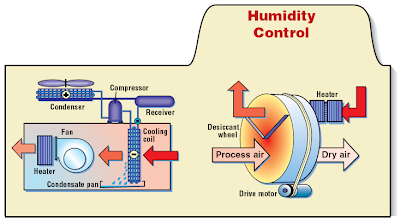
Chemical Engineering JUNE 2008 release has shared a new FAYF. This FAYF is related to some tips on Dehumidification.

What is Dehumidification ?
Dehumidification is a process to reduce the level of humidity in air to a level for good health, cleanliness and preserve structure & quality of material.

Why dehumidify air ?
Human health - As humid air can cause mold and mildew to grow inside homes, it potentially increases human health risks.

Prevent moisture regain
- Dried food such as rice, bread, etc are dry in nature to maintain it structure, avoid mold growth and low decaying process, . Maintaining moisture in air prevent dry food becoming wet.

Prevent condensation - Moisture in are contact with cold surface like refrigerant pipe, fridge, etc would cause condensation.

Prevent corrosion - Condensed water on metal surface would promote corrosion.

Drying - Dried air can be used to reduce moisture content in product.

How air is Dehumidify ?
Three methods are common used in dehumidifying. There are :
(i) Cooling
- Cool air below dew point and moisture in the air is condensed and drained out.

(ii) Adsorption
- Humidity is reduced with an adsorbent material as silica gel or activated alumina. Adsorption is a physical process where moisture is condensed and kept in material. Adsorbent material can be reactivated by passing hot gas.

(iii) Absorption
- Humidity is reduced with an absorbent material such as calcium chloride solution. Absorption involves a change in the physical or chemical structure of the material.

In this FAYF, only Cooling and Adsorption process are discussed.

In addition, the FAYF briefly compare the advantages and disadvantages of Cooling and Adsorption process. Basically cooling is economic and consider when dew pointing level is not that stringent. Adsorption process is used when a very dry air is required.

Read more in...


FAYF - DEHUMIDIFIER
(Click here*)


Note :
*This FAYF is only available FREE to Chemical Engineering Magazine registered user. Login required. Registration FREE.
** Download immediately as article available FREE within short period (JUNE 2008 only)
*** Found lost link or unable to download, may contact me...

Technology

Tuesday, April 8, 2008

Therminol Reference Disk - Assist you to Optimize your Heat Transfer System

Display problem ? Click HERE


Solutia has just released Therminol Reference Disk 5.0. If you have not known, Therminol Reference Disk combines the Therminol Reference Disk and Therminol Data Disk programs into one package which can assist you to optimize your heat transfer system.

The new disk contains tremendous amount of data and designed like a website. Users can navigate easily through 12 different sections. These sections include product information, a fluid selection guide, design guides, technical service tips, contacts, and software support.

Interested ? Click here to obtain a copy

Heat Transfer

Continue receive FREE stuff & Update.......Subscribe by Email OR RSS
Any comments / advices ?..........Drop it in comment field (below) or send a private email to me...

Wednesday, April 2, 2008

FAYF - TIPS on Heat Transfer Fluid

Display problem ? Click HERE


CHEMICAL ENGINEERING magazine again shared another useful FAYF for Heat Transfer Fluid. (This article sponsored by THERMINOL)

This sheet contains very useful TIPS for handling Heat Transfer Fluid during Start-up, Operation and Shutdown. Operation and Process Engineer like you handling Heat transfer fluid in plant heating system, please take this opportunity to read this article. You may be an expert in this area, but this article may refresh your mind or you may find some hints or shortcut in doing things...

Download... Click HERE.

Related Post

Continue receive FREE stuff & Update.......Subscribe by Email OR RSS
Any comments / advices ?..........Drop it in comment field (below) or send a private email to me...

Monday, October 1, 2007

Get The Most out of Waste Heat (Exergy approach)

Display problem ?... Click HERE

Chemical & Process plant is energy intensive industry. However, so far waste energy in the form of heat, noise, vibration, etc is dissipated to environment without or with some level of recovery. Example of heat recovery is the waste heat recovery unit (WHRU) located at the Gas turbine flue gas outlet, economizer at the boiler flue gas outlet, etc. Generally the flue gas exit temperature still rather high i.e. 250 degC, as compare to ambient temperature of 30 degC, believe there is still heat can be recovered from temperature perspective. But how much energy can be recovered and it this worth for recovery ? How to measure quantity of heat recovered to generate work ?
Exergy is the term to measure the capability of a hot fluid to produce work.

Raynald Labrecque & Kiari Goni Boulame


Above article has described a simplified approach to evaluate the exergy content of a hot waste and estimate amount of useful energy can be recovered from waste gases.

Update :
May 24, 2008 : The FREE download no longer applicable. Only Chemical Engineering member can download the article.

Related Topics


Thursday, September 27, 2007

Practical Design Tips for Heat Exchanger Design

Heat Exchanger design is one of the common activities in plant design. However, although Heat Exchanger is designed in proper manner and follow most of the good engineering & design procedure, yet you might fails to achieve the desired performance by a wide margin. With an understanding of some common reasons why this might happen, designers can avoid these problems in the first place, and troubleshooters can recognize the root causes quickly.


Exchangers for single-phase operation, condensing and boiling are considered in that order here; but as we shall see, exchangers often handle a combination of these, and it is not always obvious which process is causing the problem. In fact, some of these problems are quite unexpected and can even take experienced designers by surprise. It must be recognized that the most important cause of problems in exchangers is excessive fouling. Other articles, books, and conferences have been dedicated to this problem, so fouling will not be addressed here. Instead we consider those exchangers that have failed for some reason other than fouling.

Related Topics


Continue receive FREE stuff & Update.......Subscribe by Email OR RSS
Any comments / advices ?..........Drop it in comment field (below) or sent a private email to me...

Monday, August 20, 2007

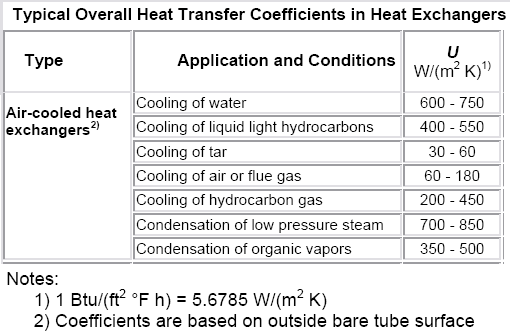
Heat Transfer Coefficient For Air-Cooled Heat Exchangers


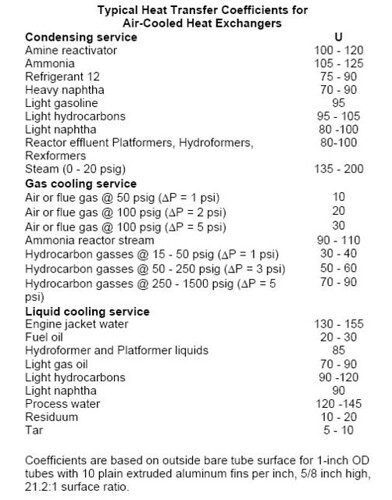
Basic heat transfer relationships is apply to Air-Cooled Heat Exchanger (ACHE) . The fundamental heat transfer equation :

Q = U. A. LMTD.F
where
U = overall heat transfer coefficient
A = Heat transfer area
LMTD = Log mean temperature difference
F = Correction factor


Typical heat transfer coefficient for Air-Cooled Heat Exchangers


Source : DELTA T
Further Reading


Continue receive FREE stuff & Update.......Subscribe by Email OR RSS
Any comments / advices ?..........Drop it in comment field (below) or sent a private email to me...

Wednesday, August 8, 2007

COLLECTION of Fouling Factor (FF) use in Heat Exchanger Design

Fouling in heat exchanger has been discussed in several posts. There are :


Fouling factor is generally used in the design to cater for heat exchanger deficiency resulted by fouling. TEMA has based on many years of experiences and experiments list out fouling factor for Shell & Tube Heat Exchanger for many services. Only TEMA subscribers are eligible to use this information. However, there are several reputable researchers & manufacturers have shared this information to the public. Following are the collection of fouling factors for different service.

If you know some other site contain similar information, please kindly drop a note to me. I will park it here.


Continue receive FREE stuff & Update.......Subscribe by Email OR RSS
Any comments / advices ?..........Drop it in comment field (below) or sent a private email to me...

Saturday, August 4, 2007

ECI - Operation & Maintenance Engineers Don't miss FREE articles (>40) related to HX Fouling & Cleaning [Part 1]


ECI - Engineering Conferences International Symposium Series
Engineering Conferences International (ECI) is a global engineering conferences program, originally established in 1962, that provides opportunities for the exploration of problems and issues of concern to engineers and scientists from many disciplines. ECI is a not-for-profit partnership between the Engineering Conferences Foundation (ECF) and Polytechnic University.
If you are engineer working in plant and experiencing Heat Exchnager fouling problem...huh...here is the place where you may find your answer.
There are many FREE articles (>40) related to fouling and cleaning of Heat Exchanger available for download from ECI.
[More]


Continue receive FREE stuff & Update.......Subscribe by Email OR RSS
Any comments / advices ?..........Drop it in comment field (below) or sent a private email to me...

Thursday, August 2, 2007

COLLECTION of Typical Overall Heat Transfer Coefficient (U-factor)


Many of us are very familiar with this fundamental equation in heat transfer.

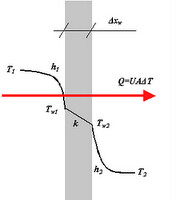
Q = U.A.ΔT


For a given heat transfer service with known mass flow rates and inlet and outlet temperatures the determination of Q is straightforward and ΔT can be easily calculated if a flow arrangement is selected (e.g. logarithmic mean temperature difference for pure countercurrent or cocurrent flow). This is different for the overall heat transfer coefficient U. The determination of U is often tedious and needs data not yet available in preliminary stages of the design. Therefore, typical values of U are useful for quickly estimating the required surface area. The literature has many tabulations of such typical coefficients for commercial heat transfer services. The links below tabulates U values for different applications and heat exchanger types.
If you aware of any site have similar information, i would be happy to include them here for the benefits of ALL within our community.


Continue receive FREE stuff & Update.......Subscribe by Email OR RSS
Any comments / advices ?..........Drop it in comment field (below) or sent a private email to me...

Saturday, July 28, 2007

FAYF - Heat Transfer - Useful Heat Transfer Equation


CHEMICAL ENGINEERING magazine shared the following useful information....
Some of you may already aware of this table. However, i would like to park here for the benifits of :
  • those who still don't know
  • those lazy to do filing
  • those who knew but failed to locate it again
This sheet contains very useful Heat Transfer Equations which commonly use by many engineers, designers, educators, students, etc. The equations include :
  • Basic equations For Conduction, Convection & Radiation
  • Basic equations use in Shell-and-Tube-Heat-Exchanger
  • Basic equation for Batch Heating
  • Basic equations for Steady State Heat Flow by Conduction
Further Reading


Continue receive FREE stuff & Update.......Subscribe by Email OR RSS
Any comments / advices ?..........Drop it in comment field (below) or sent a private email to me...

Monday, July 16, 2007

How to design Shell and Tube Heat Exchanger...


Let's some interesting articles from Dr.R. Shankar Subramanian, University of Clarkson
How to Design a Shell-and-Tube Heat Exchanger

A lot has been written about designing heat exchangers, and specifically, shell-and-tube heat exchangers. For example, the book by Kern (1) published in 1950 details basic design procedures for a variety of heat exchangers. Since the publication of that book, with the advent of computers, design procedures have become sophisticated even though the basic goals of design remain the same. Because it is possible to specify an infinite number of different heat exchangers that would perform the given service (heat load), we have to identify the specific heat exchanger that would do it subject to certain constraints. These constraints can be based on allowable pressure drop considerations either on the shell-side or on the tube-side or both, and usually include that of minimizing the overall cost. An article in 1979 by Taborek (2) outlines how heat exchanger design techniques evolved over the years since the appearance of the book by Kern. More recent developments are discussed in numerous articles in the magazine “Chemical Engineering.”
Here is a step-by-step approach to specifying a new shell-and-tube heat exchanger. We shall focus on sensible heat transfer, and make extensive use of Chapter 11 in Perry’s Handbook (3). From hereon, references to page numbers, table numbers, and equation numbers are from Perry’s Handbook.
R. Shankar Subramanian,
University of Clarkson


Continue receive FREE stuff & Update.......Subscribe by Email OR RSS
Any comments / advices ?..........Drop it in comment field (below) or sent a private email to me...

Sunday, July 15, 2007

Heat Transfer - Internal and External Flow


Wanna to share some findings today...some notes from Dr. Shankar Subramanian, University of Clarkson.
Heat Transfer to or from a Fluid Flowing Through a Tube

A common situation encountered by the chemical engineer is heat transfer to fluid flowing through a tube. This can occur in heat exchangers, boilers, condensers, evaporators, and a host of other process equipment. Therefore, it is useful to know how to estimate heat transfer coefficients in this situation.
We can classify the flow of a fluid in a straight circular tube into either laminar or turbulent flow. It is assumed from hereon that we assume fully developed incompressible, Newtonian, steady flow conditions. Fully developed flow implies that the tube is long compared with the entrance length in which the velocity distribution at the inlet adjusts itself to the geometry and no longer changes with distance along the tube.
R. Shankar Subramanian,
University of Clarkson
External flows occur when the fluid is confined in such a large channel or container such that it can be considered practically unbounded in extent when considering heat transfer to a stationary solid surface. The ideal starting point for this is flow over a flat plate that is long and wide. We know that in this situation, for flow at large values of a suitably defined Reynolds number, a boundary layer forms on the surface in which the velocity varies from zero (no slip) at the solid surface to the value in the free stream. Outside the boundary layer, viscous forces are entirely negligible, and potential flow can be assumed to prevail. Potential flow means flow in which the vorticity is zero and viscous forces are neglected.
R. Shankar Subramanian,
University of Clarkson


Continue receive FREE stuff & Update.......Subscribe by Email OR RSS
Any comments / advices ?..........Drop it in comment field (below) or sent a private email to me...

Thursday, June 28, 2007

FREE E-book........A Heat Tranfer Textbook


Copyright (c) 2000-2006 by John H. Lienhard IV and John H. Lienhard V. All rights reserved.

This ebook discusses on several topics related to heat transfer and heat exchange. It content cover the general problem of heat exchange, analysis of heat conduction, convective heat transfer, thermal radiation heat transfer, mass transfer, etc


Further reading


If you benifits from this post...buy me some sweets...
Continue receive FREE stuff & Update.......Subscribe by Email OR RSS
Any comments / advices ?..........Drop it in comment field (below) or sent a private email to me...